
We help businesses accept payments online.
As a rule of thumb, setting up a payment gateway for selling in the West is a pretty straightforward process. You sign up with a payment provider like Stripe or Adyen or Square, hook it up with your checkout and you’re pretty much all set up to collect money from customers in countries all over the world. Japanese payment gateways are a little different.
You see, for almost every country in the West, a standard payment gateway setup is enough. You have all the major cards, you have Apple Pay and Google Pay, you have things like buy-now-pay-later, Klarna and even localized payment options for Europe like Bancontact for Belgium and Przelewy24 (P24) for Poland.
But for Asia – and Japan specifically – that’s not the case at all.
Technically, Japanese customers can pay with the cards your checkout already takes. But a lot of them would rather pay another way.
For example, a Japanese customer might want to place an order with you in the evening and pay for it on their way to work in the morning, in cash, at the convenience store. Another customer might want to make a big purchase and want to pay by bank transfer. And another customer might look to see if they can earn loyalty points on their purchase before they checkout.
If you’re only familiar with Western checkouts that don’t offer those options, then you probably wouldn’t ever think to add them. But in Japan, there are nuances to adapting your store and your checkout for a Japanese consumer that go beyond translating your copy and pricing your products in yen.
So this guide goes through the ten questions merchants ask us most often when they start to take payments in Japan. We’ll cover things like:
- why Japan is different
- what payment methods you need to succeed
- whether you need a Japanese company
- how long it takes
- how you get paid
- what it costs
- which rules and laws apply
1. Why is taking payments in Japan different from anywhere else I sell?
One of the biggest adjustments for merchants selling into Japan is getting their head around the nuances of Japanese payment culture.
Unlike other countries – which tend to follow a fairly boilerplate payment stack of credit and debit cards plus BNPL, digital wallets and a local option or two – Japan has an entire ecosystem of payment methods that don’t exist anywhere else in the world.
And, to make things even more nuanced, Japanese shoppers tend to have a preferred way of paying that they trust and tend to abandon a purchase rather than using an alternative method.
Think of it this way. When you imagine a shopper ordering from Paris or Texas, if they can’t use the payment option they wanted — say, your checkout doesn’t offer PayPal or Klarna or AmEx – then around 80% of the time, the customer will choose another method instead and finish their order.
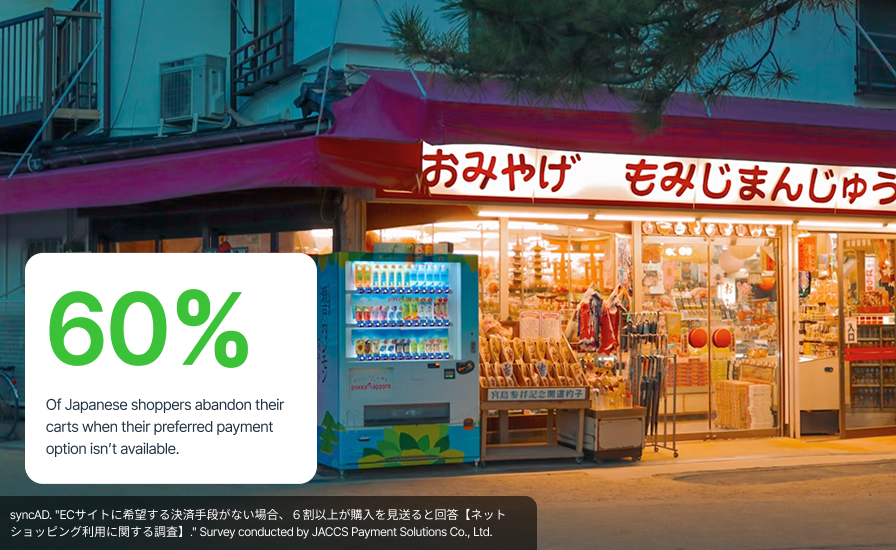
In Japan, that’s much less likely. A 2022 survey by JACCS Payment Solutions found that over 60% of Japanese shoppers abandon a purchase altogether when their preferred payment method isn’t available.
If you want to understand the nuances of the Japanese market fully, we’ve written an in-depth guide, but the short answer is that Japan’s payment culture is far more tied to traditional and cultural heritage than most other countries in the world.
For example, cash is still widely used and trusted, even for online payments. Japanese citizens hold cash worth around 20% of its GDP, compared with roughly 8% in the US and under 1% in Sweden. Storing cash is so common, there’s even a Japanese word for savings kept at home rather than in a bank: tansu yokin, which translates as savings in the chest of drawers.
In fact, estimates suggest around 50% of Japan’s currency in circulation isn’t actually circulating, it’s sitting in people’s homes. This is a reflection of a long-standing cultural relationship with cash that sees it as something tangible, safe, and – importantly – something that still works when the power is down in the event of something like an earthquake.
Another nuance is Japan’s relationship with debt. Japan’s credit card penetration is around 86% — which is slightly higher than the US — but average credit card debt is significantly lower because Japanese cardholders avoid using revolving credit.
In fact, the usual habit is to pay the full balance off in one go each month rather than pay it off month-after-month. And there’s a name for that too: ikkai barai.
And there’s the matter of fraud. Credit card fraud in Japan reached a record ¥55.5 billion in 2024, and most of it came from card numbers stolen and used on shopping websites.
Put all of those things together and you realise that while Japanese shoppers might be happy to use their card in certain circumstances, they’re likely to still prefer an alternative payment method on a website they’ve never bought from before. And for those shoppers, paying in cash, by bank transfer or through an app they already use feels safer and more familiar than entering card details into your checkout.
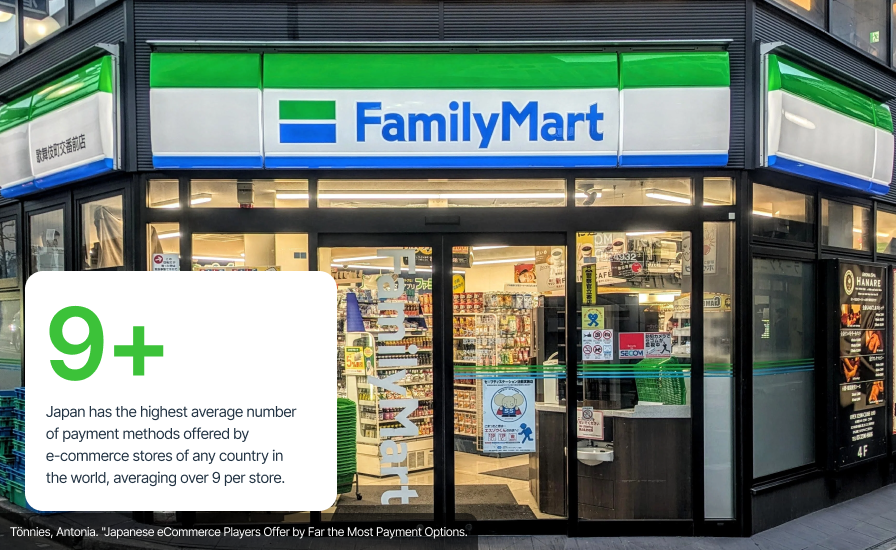
And that’s exactly why Japanese online stores have adapted by offering far more ways to pay than any other country in the world. ECDB puts the average Japanese online store at 9.5 payment methods while most Western stores offer four or five.
In short, adapting your checkout to Western markets is often a case of just adding a localized payment method or two. Adapting your checkout for Japan means adapting for a completely different culture and attitude towards money.
2. Do I need to use one of the Japanese payment gateways at all, or can I use Stripe or Shopify Payments?
If you’re launching in Japan, you don’t absolutely need a Japanese payment gateway to take payments. Some global payment gateways, such as Stripe or Shopify Payments, let you add a few Japanese payment methods to your checkout in a few clicks.
(Editor’s note: a payment gateway, or payment provider, is the service that sits between your checkout and the payment networks, passing the customer’s payment through and paying the money out to you. A Japanese payment gateway – like KOMOJU – does the same thing for Japanese and Asian payment methods.)
For example, a Stripe account in the UK, US or EU allows you to accept credit cards, including JCB, Japan’s own card network.
And on the surface, offering JCB and other cards as a payment option would appear to cover a good share of Japanese shoppers. After all, Japan uses cards for online shopping more than any other country according to Worldpay’s Global Payments Report 2026. In fact, cards make up just over half of Japan’s online spending.
However, what that doesn’t show is that cards only work best in Japan once a shopper already trusts you. For a first order or a brand launching in Japan or a brand that Japanese customers don’t yet know as a household name, that trust isn’t there yet. A Japanese shopper might use their card happily in a shop, and still not want to type it into a website they’ve never bought from before.
And that is where the local payment methods come in. Konbini (convenience store) payments, bank transfer, Pay-easy, apps like PayPay, and paying through a phone bill are all payment methods that Japanese customers prefer to use to buy things from online stores they’re not familiar with.
Which is why a Japanese payment gateway is essential for stores looking to grow their Japanese customer base.
As we saw in our breakdown of Stripe vs KOMOJU, although global payment gateways offer a few Japanese payment methods, they’re far from comprehensive.
On the other hand, a Japanese payment gateway like KOMOJU lets you add konbini, bank transfer, Pay-easy and apps like PayPay to your checkout. And it doesn’t replace the provider you already have.
In fact, on most eCommerce platforms, including Shopify and WooCommerce, you can add a Japanese gateway alongside the one you’re already using. Your current provider keeps handling cards and your other markets while the Japanese one adds the local options next to it. Your customer just sees one checkout with more ways to pay.
3. Do I need a company in Japan to accept Japanese payments?
This is another question that trips a lot of merchants up because – as much as we’d like to give you a simple answer – the truth is a little more complicated.
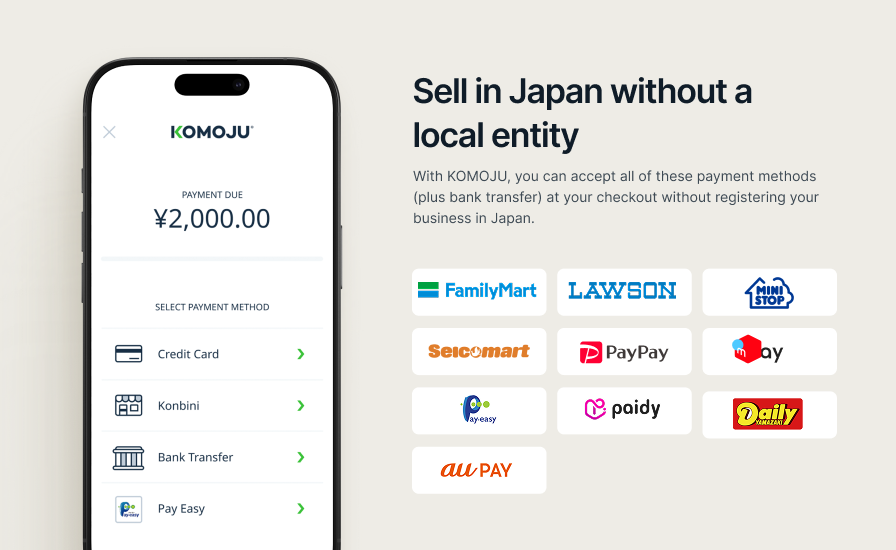
In short, you don’t need a Japanese company to start accepting some of Japan’s most common payment methods, including konbini payments and bank transfer, but you’ll need one for others, such as 7-Eleven and Rakuten Pay.
In Japan, this is called a local entity. Essentially, it’s a company legally registered in Japan and set up with a Japanese corporate registration, a local tax ID, and usually a local address. And some Japanese payment methods require you to have one in order to accept them.
However, getting a local entity often involves months of paperwork (in Japanese) and ongoing cost, so many merchants prefer to launch and validate the market before they do this.
Which is exactly why, for a lot of Japanese methods, KOMOJU doesn’t require you to have a local entity set up.
In fact, with KOMOJU you can launch in Japan with the following payment methods without a local entity:
- Konbini store payments
- Family Mart
- Lawson
- Mini Stop
- Daily Yamazaki
- SeicoMart
- Pay Easy
- Furikomi (bank transfer)
- Paidy
- WebMoney (for digital content)
(Exemptions may apply depending on business model and size of business.)
Even without the full range and a local entity, that gives you a really strong first step into selling in Japan.
With those payment methods set up, you’re already covering a lot of the bases you need to be successful in Japan. Adding konbini alone handles around 18% of Japan’s B2C eCommerce, close to ¥3 trillion a year, and bank transfer reaches almost every adult in the country, since virtually every Japanese resident has a bank account.
4. How long until I can take my first Japanese payment?
This is another question without a neat answer. Essentially, how quickly you can take your first Japanese payment depends on which methods you decide to launch with.
For most merchants that get set up with KOMOJU, they can accept Japanese payments in a matter of days, not months. And, of course, you don’t need to add every Japanese payment method at once to start selling.
Cards are the simplest to get approved for. In fact, for a lot of merchants they’re already live, especially if your current provider already handles Japanese cards. (e.g. a Stripe account in the UK, US or EU does, and Shopify Payments does depending on your account’s eligibility.)
After that, the payment methods that don’t require a local entity – including five of the major konbini chains, bank transfer, Pay-easy, Paidy and WebMoney (for digital content) – are all available and just require one application covering your business and a payment-specific approval on top. That takes a few business days per method, in most cases.
After that, everything needs a Japanese entity, and that’s really the only time-consuming part. However, once you’ve done that, you can add 7-Eleven, Rakuten Pay, d Payment, carrier billing, other prepaid wallets, and card processing through a Japanese bank. The registration itself takes months, however.
(Editor’s note: Methods like 7-Eleven also run their own separate review once you apply.)
5. Which payment methods do Japanese customers want to see?
Japanese customers typically expect to see at least JCB, konbini, PayPay, Rakuten Pay, bank transfer or Pay-easy, and carrier billing options on your checkout.
But because Japan’s payment landscape has fragmented into dozens of competing methods — digital wallets, IC cards, carrier billing, bank transfer networks, konbini systems — it’s unrealistic to expect every store to have them all. The key is to have a spread across the different payment methods.
Konbini payments
Konbini payments let customers buy something online and then go and pay for it in cash at their local konbini. (Think 7-Eleven or convenience store.)
These payments exist because Japan is still a cash-first culture and many shoppers trust cash over card payments, so Japan has a system that has adapted to this online-meets-offline, digital-meets-physical contradiction at the heart of so much of Japan’s payment landscape.
And while taking cash for online orders sounds complex, it’s actually quite simple. At your checkout, the shopper selects konbini payments and receives a reference code. They take it to any convenience store — 7-Eleven, Lawson, FamilyMart — pay cash over the counter, and confirmation arrives within the hour. You don’t ship until confirmed. (Which also eliminates chargebacks entirely.)
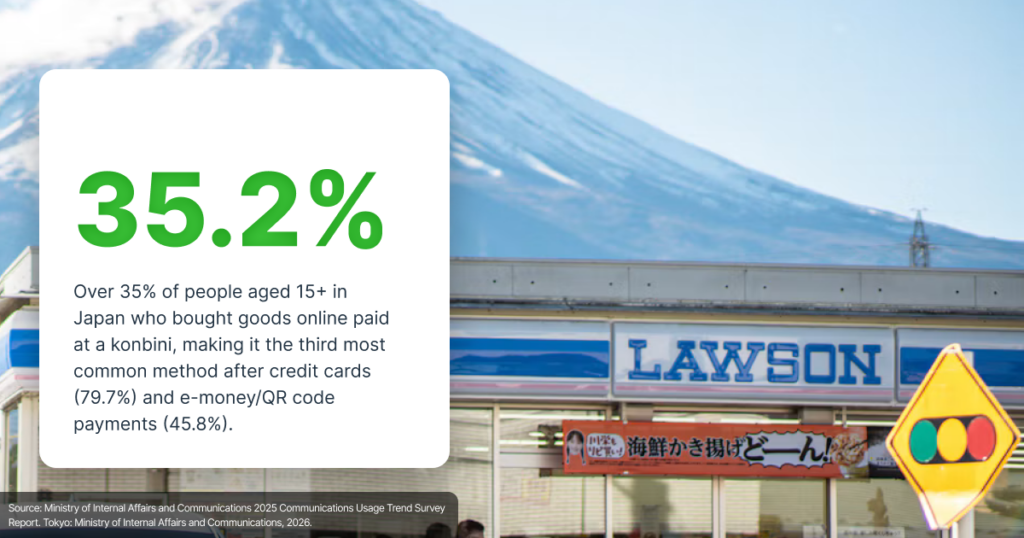
And it’s a good one to add to convert more Japanese customers, too. In fact, over 20% of Japanese online shoppers use or plan to use konbini to make an online purchase and there are 56,000+ convenience stores nationwide. In fact, nearly half of Japanese consumers visit a convenience store (konbini) at least once a week, so the infrastructure is already woven into daily life.
PayPay
PayPay gives the younger generation of Japanese consumers the convenience of digital payments without any of the cultural weight that debt carries in Japan.
With PayPay, customers load it like a wallet and spend the money. That’s it.
There’s no debt and it doesn’t require them to enter card details on a website. And for a younger Japanese shopper, not seeing it at checkout is roughly equivalent to a Western store not accepting Klarna or Apple Pay.
In fact, PayPay had over 70 million registered users as of July 2025, which is more than one in two people in Japan, rising to 72 million by December 2025. In fact, PayPay accounts for roughly 20% of all cashless transactions in the country, including credit cards.
When a customer uses PayPay at your checkout, all they need to do is select PayPay, scan a QR code with their app and make the payment. It appears instantly in your dashboard.
Rakuten Pay
Rakuten Pay allows customers to collect and spend Rakuten Points – Japan’s biggest loyalty scheme – at your checkout. And in Japan, loyalty points are everything.
In fact, Japanese shoppers spend a huge amount of time planning their spending around where they’ll earn and spend rewards. Rakuten Points are used by nearly 60% of Japanese consumers, and they’re not confined to Rakuten’s own marketplace at all. The same points work across more than 70 Rakuten services, from shopping to travel to banking to mobile to beauty.
On top of that, almost half of Japanese consumers say they choose which website to buy from based on whether it rewards them with points. In Japan, points aren’t a reward for spending. They’re almost a second currency that customers use to decide where they shop in the first place.
JCB
Offering JCB in Japan is like offering Visa or Mastercard in Western markets.
JCB is Japan’s only domestically-founded credit card brand. Founded in Tokyo in 1961, JCB was built specifically to serve Japanese consumers on Japanese terms. Over six decades it’s become embedded in the banking and loyalty infrastructure in a way that Visa and Mastercard simply aren’t, with 169.8 million cardholders globally.
Many Japanese consumers hold a JCB card as their primary card, often through a co-branded product tied to their bank, their employer, or their loyalty programme.
However, JCB acceptance isn’t automatic for foreign merchants. It has to be explicitly enabled through your payment provider and requires a local entity to get set up.
Bank transfers (like Pay-easy)
Pay-easy is Japan’s online bank transfer system, integrated directly with the country’s major banks and ATM networks.
At checkout, the shopper receives payment details and completes the transfer through their online banking or at an ATM, with no card details entered. And because 98% of Japan’s population holds a bank account, Pay-easy makes your store accessible to virtually every Japanese consumer.
For significant purchases — electronics, luxury goods, anything where the order value creates hesitation about card exposure — some Japanese consumers actively prefer this method.
Carrier billing
In Western markets, mobile carriers let you make calls and that’s pretty much it.
In Japan, the three major carriers — NTT Docomo, au by KDDI, and SoftBank — are closer to financial infrastructure than they are mobile networks, letting customers make purchases and pay them off their phone bills.
For a significant portion of Japanese consumers, their mobile carrier is already part of how they manage their money, not just how they make calls.
Carrier billing lets your customers charge the purchase directly to their phone bill. And for younger consumers who may not yet hold a credit card, or digital product buyers who want the most frictionless path from intent to purchase, it removes every remaining barrier.
6. How do konbini payments work? Can you really let customers pay cash for an online order?
Konbini payments are probably the biggest cultural shift to selling in Japan that overseas merchants have to get their head around.
After all, aside from things like ordering a take out from your local pizza place, cash on delivery isn’t a mainstream payment in Western countries at all. But in Japan, it’s the norm.
In short, konbini payments let a customer order online and pay in cash at a convenience store afterwards. If they don’t pay before the deadline you set, the order expires and nothing is shipped.
Konbini is the everyday Japanese word for a convenience store. But they actually do a lot more than their Western equivalents: Japanese customers can pay utility bills there, pick up parcels, withdraw cash, print documents and pay for things they’ve ordered online.
In fact, nearly half of Japanese consumers visit one at least once a week. The biggest chains are 7-Eleven, with over 21,000 stores, FamilyMart, with around 16,000, and Lawson, with around 14,000.
From the customer’s side, konbini payments work like this:
- At your checkout, they choose konbini as the payment method and pick which chain they’ll pay at.
- They receive a payment code by email, with instructions in Japanese.
- At the store, they enter the code at a machine or show it at the till, then pay in cash.
From the merchant’s side:
- The order is created but marked as unpaid, so you don’t ship anything yet.
- When the customer pays at the store, we confirm the payment automatically, usually within an hour.
- That confirmation is your signal to ship.
If you’re used to card payments, where the money passes hands the moment someone clicks buy, this can feel back to front. The order comes in and the money lands much later. But because nothing ships until the cash has been paid, it almost functions as a form of prepayment. And on your end, the order is only complete and ready to ship once the konbini payment has been made.
So what happens if someone never pays?
This is the other concern that merchants have about accepting konbini payments. What happens if they order but don’t pay? Well, all that happens is the payment code expires at the end of the window you’ve set, and the order is cancelled. You haven’t shipped anything, so it hasn’t cost you anything.
Plus, you decide how long the window is. The KOMOJU default is three days, and you can set anything from one to 59. You can also have us send the customer a reminder email the day before the window closes.
A single konbini payment can be up to ¥300,000. Customers pay a small fixed fee at the till, which is standard in Japan and something shoppers here expect.
And because the customer pays in cash, there’s no card payment that can be reversed later.
7. How often do Japanese customers dispute payments, and how do returns work?
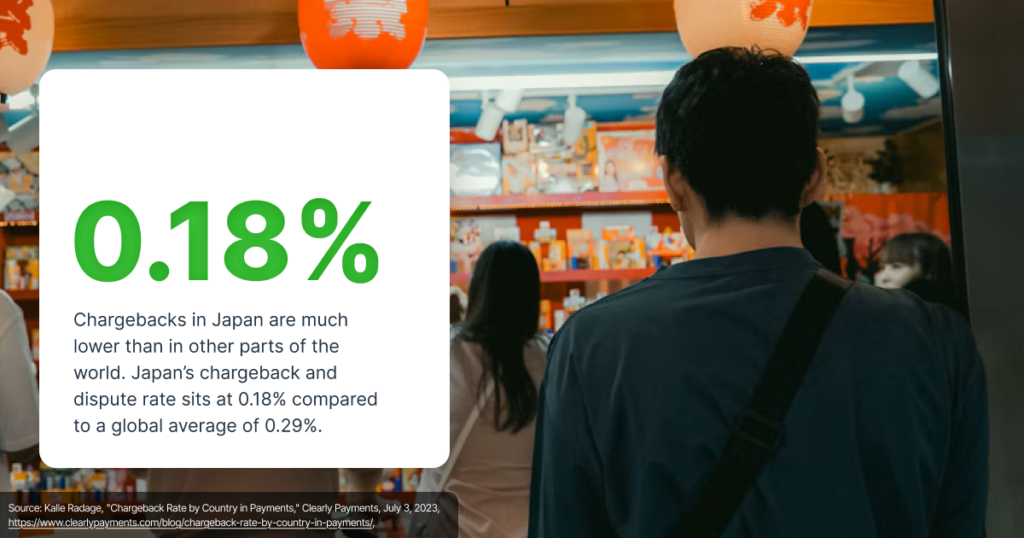
Japan’s chargeback and dispute rate is actually very low compared to most countries and eCommerce benchmarks. This is likely because Japanese shoppers are cautious and do a lot of research before they buy anything.
A chargeback is when a customer disputes a card payment with their bank and the bank reverses it. Japan’s rate is commonly cited at around 0.18%, which is well below what’s typical for eCommerce elsewhere.
Part of why chargebacks stay low is because with konbini payments, bank transfer and Pay-easy, the customer pays before you ship anything, so there’s no card payment sitting there to dispute in the first place.
Returns are low in Japan too, by international standards. A 2023 industry survey put Japan’s average return rate at 6.61%, against a US and global eCommerce average usually cited between 20% and 30%.
For card payments, there’s also 3-D Secure the extra check where a bank asks the customer to confirm the payment in its app or with a one-time code.
When a payment has gone through that check and later turns out to be fraudulent, the cost generally falls on the customer’s bank rather than on you. It doesn’t cover every dispute — a customer can still dispute a payment that never arrived or wasn’t as described — but it covers fraud, which is usually the biggest driver of chargebacks.
But if a customer does dispute a payment through KOMOJU, here’s how it works: it arrives as a chargeback request with a due date attached. To defend it, all you need to do is send us a description of what happened along with supporting evidence and we’ll review everything. (Shipping and recipient details can help the case but aren’t required.)
8. How and when do I get paid? And will I need a Japanese bank account?
You don’t need a Japanese bank account to sell in Japan. KOMOJU pays out your Japanese sales in Japanese yen, US dollars or euros, on a weekly or monthly schedule you choose, and you can receive them in a bank account outside Japan.
Customers in Japan always pay in yen. The currency you’re paid out in is up to you. You can choose from yen, dollars or euros, so if your business runs in dollars or euros, you don’t have to hold yen.
With KOMOJU, you can choose between two payout schedules:
- Weekly: you get paid every Friday with the sales from the previous Saturday-Friday period
- Monthly: you get paid at the end of the month with the sales from the previous month
If a payout date falls on a bank holiday, the money is sent on the next working day.
You don’t need a Japanese bank account. However, payouts to a bank account outside Japan carry a flat transfer fee of ¥2,500 (around $15, give or take) per payout.
9. What are the costs associated with accepting Japanese payments?
With KOMOJU, accepting Japanese payments through us costs a percentage of each completed transaction, with no sign-up fee, no monthly fee and no minimum volume.
The percentage depends on the payment method, and some methods have different rates for physical products and digital goods. You’ll find the current rates on our pricing page.
The only other fee most overseas merchants pay is the flat ¥2,500 transfer fee each time we pay out to a bank account outside Japan.
If you process more than $150,000 a month, we also offer volume pricing. And if you later register a company in Japan and are paid out to a Japanese bank account, the transfer fees are lower.
10. What do I have to comply with when selling to Japan?
When you sell to consumers in Japan, there are two main sets of rules to know about: card security rules for online card payments, and consumption tax once your Japanese sales pass a certain level.
Card security and 3-D Secure
Japan’s card industry has its own security guidelines for online stores, set by the Credit Transaction Security Council, an industry body backed by Japan’s Ministry of Economy, Trade and Industry.
Since April 2025, they’ve expected online stores to use EMV 3-D Secure, the extra check at payment described above, as well as protecting their websites against hacking and fake logins.
By default, the check happens on every card payment. The guidelines also allow two alternatives:
- running the check when a customer saves a card to their account
- running it on payments the store judges to be risky
If your store has a more significant fraud problem, you also need to factor in a few extra requirements. If the fraud recorded by your store’s card processor goes over ¥500,000 in each of three months in a row, you’ll be expected to add more protections, including checking delivery addresses or holding back suspicious orders before shipping.
If you process card payments through KOMOJU, 3-D Secure 2.0 is used as standard to run those extra checks and catch fraud as standard.
Consumption tax
Consumption tax is Japan’s tax on goods and services, roughly the equivalent of VAT or sales tax, and it’s charged at 10%. Businesses based outside Japan that sell to Japanese consumers generally need to register for it and collect it once their taxable sales in Japan go over ¥10 million in the base period.
There’s also a change coming for businesses that ship goods to Japan from abroad. At the moment, parcels worth ¥10,000 or less can come into Japan without consumption tax.
From 1 April 2028, under the government’s FY2026 tax reform, that’s going to change. Low-value goods sold online and shipped into Japan will be taxed when they’re sold, and the seller will be responsible for the tax. (However, where those sales go through certain online marketplaces, the marketplace takes on that responsibility instead.)
The bottom line
Most merchants selling into Japan for the first time think of adding a Japanese payment gateway as a complete overhaul of their checkout.
And while there are cultural nuances and a lot of Japan-specific quirks you need to adapt to, selling in Japan really amounts to little more than adding a Japanese payment gateway and – if you want to offer all the payment options – getting set up with a local entity.
With KOMOJU, you can add konbini payments at five major chains, bank transfer, Pay-easy, Paidy, and WebMoney for digital content, to the same checkout, and get paid in yen, dollars, or euros with no monthly fee. And, if you register a company in Japan later, the remaining wallets, the points apps, 7-Eleven, card processing, carrier billing, and prepaid wallets can all be added to the same account.
And the best bit of all? You can keep Stripe – or whatever other global PSP you use – handling your cards and your other markets exactly as they are, and route your Japanese local payment methods through KOMOJU. That means you can accept konbini, PayPay, Rakuten Pay, carrier billing and the rest, all on the same checkout.