
We help businesses accept payments online.
Whenever we speak to merchants and brands looking to sell in Japan, one of the most common questions we hear is: do we need to set up a Japanese company to sell in Japan?
The short answer is no. Plenty of international brands sell to Japanese shoppers from their existing company, shipping orders from overseas and taking card payments through the provider they already use. They do this without setting up a local entity.
A local entity is a company that’s legally registered in Japan, with a Japanese address and tax ID, rather than your existing company back home.
However, that’s not the complete picture.
While you can sell in Japan without a local entity, the number of Japanese payment methods you will be able to offer is affected by whether you have a local entity or not.
Japanese shoppers don’t just pay by card. Many prefer to pay in cash at a konbini, or with a digital wallet like PayPay, and not all of these methods are open to companies registered outside Japan.
And in a country where more than 60% of shoppers will walk away from a purchase if they can’t use their preferred payment method, it’s important to know how much of the Japanese market you can reach without a local entity, and when it’s worth setting one up.
So we’ve put everything you need to know about Japanese local entities in one place, including:
- what a local entity is, and how it’s different from your existing company
- which Japanese payment methods need one, and which don’t
- what you can and can’t offer with Stripe before you register
- the types of entity you can set up, and what they take
- what changes once you have one
- what you still need to get right without one
- when it makes sense to register
- how to start selling in Japan before you have one
What is a local entity in Japan?
A Japanese local entity is a business legally registered in Japan, separate from the company you already run in your own country.
A local entity needs to be registered with Japan’s Legal Affairs Bureau and have its own Japanese tax registration, registered address in Japan, and Japanese bank account.
Your existing company is classified as an overseas entity in Japan, and while you can still sell to customers in Japan, Japanese banks and payment networks see it as a foreign business.
As a foreign business, the Japanese payment methods you can offer customers in Japan are limited. Most payment methods are set up through Japanese banks and partners, and those relationships are built around Japanese companies. So when a payment provider says that a method requires a local entity, it means that the contract has to be with a company registered in Japan.
In short: your current company can sell to customers in Japan, but a local entity is usually what allows you to offer the majority of Japan’s most popular payment methods.
Do you need a local entity or Japanese company to sell in Japan?
No, you don’t need a local entity to sell in Japan. There are plenty of international brands that sell to Japanese customers without a local entity.
But having a local entity changes the payment methods you can offer, which can make a big difference to how successful your brand is in Japan. Japanese shoppers are quite particular about what payment methods they use to pay, so the payment options at checkout can have a significant effect on how many customers complete their purchase.
The payment methods you can offer without a local entity depend on your payment provider. Some providers only allow card payments until you’ve registered a Japanese company, while others let you offer a much wider range of payment methods without a local entity.
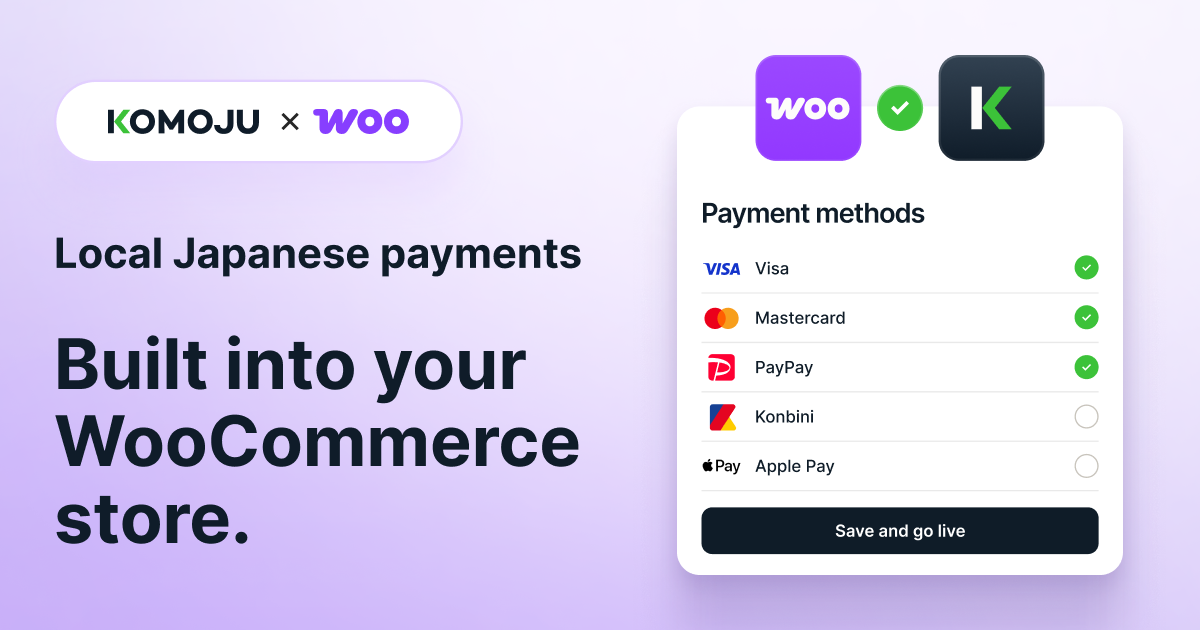
With KOMOJU, for example, you can offer konbini payments at five of Japan’s major convenience store chains, plus Pay-easy, bank transfer, WebMoney and Paidy, all without a local entity. That covers many of the most popular ways Japanese customers like to pay online.
PayPay, au PAY and Merpay may also be available without a local entity, depending on your business model and transaction volume.
So when you’re comparing payment providers, it’s definitely worth checking which Japanese payment methods each one offers without a local entity, and whether they cover enough of your customers.
Which Japanese payment methods need a local entity?
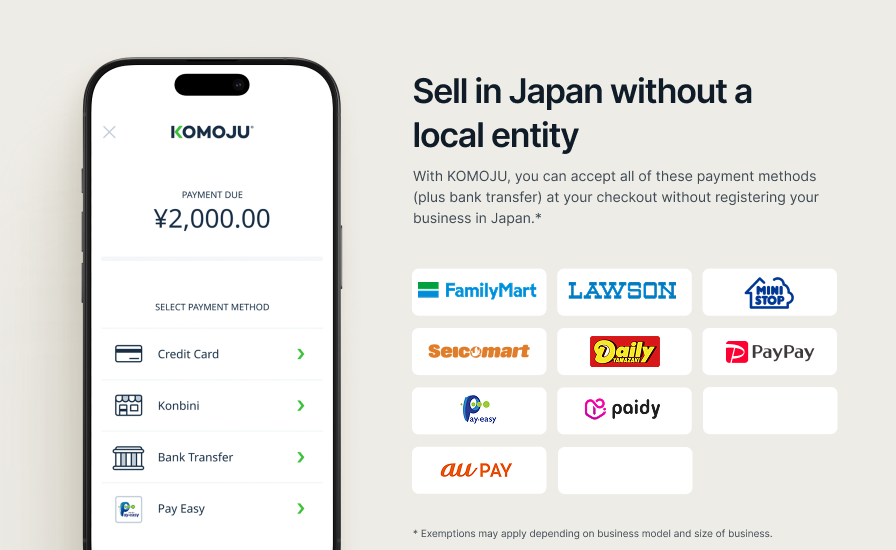
Which payment methods you can offer without a local entity depends on your payment provider. But some methods need one even with a provider like KOMOJU, including:
- Japanese card acquiring (Visa, Mastercard, JCB and others), although most international merchants already take cards through their existing provider, like Stripe or Shopify Payments
- 7-Eleven konbini payments
- Rakuten Pay
- d Payment
- Carrier billing and prepaid wallets
With some providers, popular payment methods like konbini, PayPay, and bank transfer need one too. Stripe, for example, requires a Japan-based account for all three.
With KOMOJU, though, you can offer many of the payment methods Japanese shoppers use online without a local entity, and only a handful require one.
As you can see, with KOMOJU, even without a local entity, you can still reach customers who prefer to pay in cash, people who use three of Japan’s most popular digital wallets, shoppers who pay straight from their bank account, and those who prefer to buy now and pay later.
In short: you can reach a wide range of Japanese shoppers without a local entity, and setting one up allows you to offer the rest of Japan’s most popular payment methods.
Can you use Stripe to sell in Japan without a local entity?
You can use Stripe to sell in Japan without a local entity, but only for card payments. If your Stripe account is based in the UK, US, or the EEA, you can accept Japanese cards, including JCB, without a local entity.
However, if you want to offer konbini, bank transfer, or PayPay through Stripe, you’ll need a Japan-based Stripe account, which means registering a Japanese company or a sole proprietorship first.
So until you’ve registered in Japan, a Stripe-only checkout is a card-only checkout, and cards are only one of the ways Japanese customers like to pay.
Even with a Japanese entity, there are some popular Japanese payment methods that Stripe doesn’t offer, including Rakuten Pay, au PAY, Merpay, and carrier billing.
Here’s how Stripe and KOMOJU compare, with and without a local entity:
Data accurate as of October 2026. Based on our KOMOJU vs Stripe comparison.
If you’re selling in Japan before you’ve registered a local entity, Stripe can handle your card payments, while KOMOJU can add the local payment methods Japanese customers expect at checkout.
And you don’t need to choose between the two. Many brands keep Stripe for card payments and their other markets, and add KOMOJU alongside it to offer Japanese payment methods on the same checkout.
In short: Stripe allows you to accept Japanese cards without a local entity, but if you want to offer konbini, PayPay, and other local payment methods before you register, you’ll need a provider like KOMOJU to sit alongside it.
What types of companies or local entities can you set up in Japan?
Most international brands set up either a kabushiki kaisha (KK) or a godo kaisha (GK). Both are Japanese companies owned by your existing business, and they work like subsidiaries do in most other countries.
A kabushiki kaisha is a joint-stock company, which is roughly Japan’s equivalent of a UK limited company or a US corporation. It’s the most common type of company in Japan, and it’s what most Japanese businesses expect to work with.
A godo kaisha is a limited liability company, closer to a US LLC. It’s cheaper and simpler to set up and run, and unlike a KK, it doesn’t have to publish its financial results.
With both a KK and a GK, your liability is limited to the amount you’ve invested in the company, as they’re legally separate from your head office.
A branch office is the other main option. It’s registered in Japan and can trade there, but it isn’t a separate company. You may also come across representative offices, but these can only do groundwork like market research and advertising and won’t help you sell to Japanese customers.
(There are a few other types, like partnerships, but international brands rarely use them.)
The right choice for your brand depends on your plans, your tax position, and how your business is set up in your own country. In a lot of cases, it’s worth speaking to a Japanese legal or tax adviser before you decide. JETRO, Japan’s government trade organisation, also offers free support to foreign businesses setting up in Japan.
How long does it take to set up a local entity, and how much does it cost?
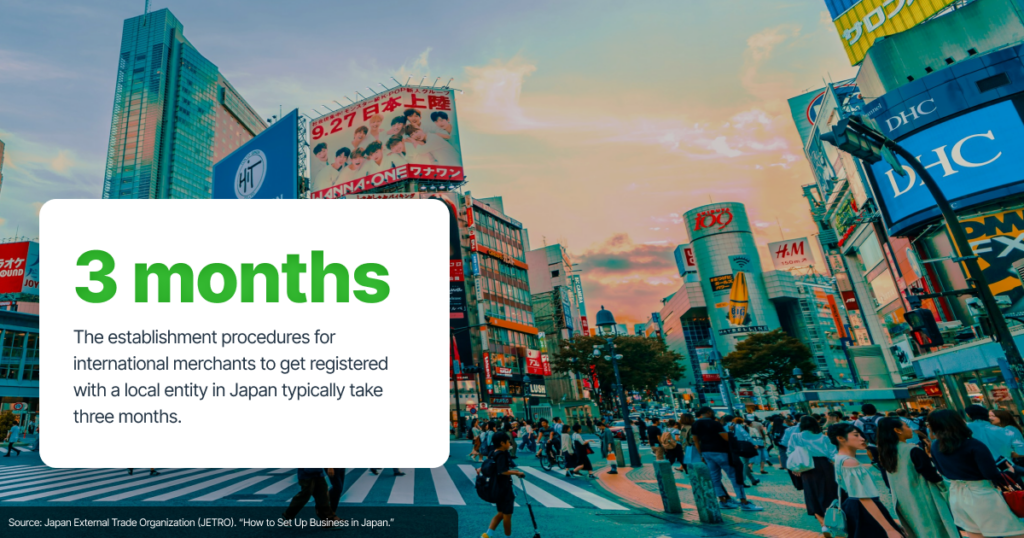
Setting up a Japanese company usually takes around three months, and registration costs start at around ¥250,000 (roughly $1,650), according to JETRO.
Most international brands also use a Japanese legal or tax firm to handle the paperwork, which is all in Japanese, and this usually adds another ¥200,000 to ¥500,000 (roughly $1,300 to $3,300) in professional fees.
Part of the registration cost is a tax of 0.7% of your company’s starting capital, with a minimum of ¥150,000 for a KK and ¥60,000 for a GK.
A KK also needs its founding documents checked by a notary, while a GK doesn’t, which is one of the reasons a GK is cheaper to set up. A branch office is cheaper again, with registration costs starting at around ¥100,000 or roughly $660.
The setup process usually looks something like this:
- Choose your entity type and write up the company’s articles of incorporation (in Japanese).
- Have the articles checked by a notary (KK only).
- Pay your starting capital into a bank account.
- Register the company with the Legal Affairs Bureau.
- Send your tax and social insurance notifications to the relevant offices.
- Open a Japanese company bank account.
Opening a bank account is often the slowest step, as Japanese banks check applications carefully and can turn them down.
You’ll also need someone to act as the company’s representative, a registered address in Japan, and a set of company seals (the stamps Japanese companies use to sign official documents). JETRO also notes that the representative may need to be in Japan for parts of the setup process.
Once your company is up and running, there are also ongoing costs to plan for, including accounting, yearly tax filings, local company taxes, and payroll and social insurance if you hire people in Japan.
What are the advantages to having a local entity?
A local entity mainly changes two things: the number of payment methods you can offer, and how easily you can build a long-term presence in Japan.
You can offer all of Japan's local payment methods
With a local entity, there are far fewer restrictions on what payment methods you can accept at your checkout.
For example, with a local entity, you can add 7-Eleven, Japan’s biggest convenience store chain, as well as Rakuten Pay and d Payment, two of the country’s biggest points programmes.
Rakuten Points alone are used by close to 60% of Japanese consumers, so for a lot of brands, being able to offer Rakuten Pay can make a real difference. (Our Rakuten Pay guide goes into more detail.)
Your card payments are more likely to go through
With a local entity, you can process card payments through a Japanese acquirer instead of routing them cross-border. Japanese card issuers are more likely to approve local transactions. JCB, for example, approves around 92% of local payments in Japan, roughly 8 percentage points more than cross-border ones. That means fewer declined payments at checkout and fewer lost sales.
You're set up for a long-term presence in Japan
A local entity also allows you to open a Japanese bank account, get paid in yen locally, hire staff, and sign contracts with Japanese partners and marketplaces.
Customers can see you’re a Japanese business
A local entity gives you a Japanese company name and address to show on your store. For shoppers who haven’t bought from you before, that can be a reassuring sign that you’re here for the long term and easy to reach if something goes wrong.
However, it’s not a shortcut to localization
A local entity won’t localize your store for you. Yen pricing, Japanese copy, and offering the right mix of payment methods will still decide whether customers buy from you.
A local entity also comes with its own ongoing costs and Japanese tax obligations, so it’s worth factoring those in before you register.
What rules apply to businesses selling in Japan, local entity or not?
Japanese rules still apply when you sell to customers in Japan without a local entity, but for most brands, there are only a few things to get right.
Show your business details on your store
Japan’s Act on Specified Commercial Transactions requires online stores to show who’s selling. This includes your business name, address, and phone number, along with your prices, shipping costs, payment methods, and return policy.
Most Japanese stores put all of this on one page, usually called “Notation based on the Specified Commercial Transactions Act”, and Japanese shoppers know to look for it. Your overseas business address is fine here, so you don’t need a Japanese one.
Get Japanese consumption tax right
If you sell physical goods, Japanese consumption tax (JCT) is generally collected at customs when your orders arrive in Japan, so it’s worth deciding whether you or your customer will pay it.
If you sell digital services to customers in Japan, like apps, games, or streaming, you may need to register for and pay JCT yourself, even as a foreign business. Since April 2025, if you sell through a large app store or digital platform, the platform may handle this tax for you.
Follow Japan's card security rules
Japan’s Credit Card Security Guidelines require online stores to use EMV 3D Secure (an extra identity check from the card issuer) for card payments, and not to store card details.
Using a payment provider that handles 3D Secure and keeps card details off your systems takes care of most of this for you.
Check the rules if you sell gift cards or in-game currency
If you sell anything that customers pay for upfront and spend later, like gift cards or in-game currency, Japan’s Payment Services Act may apply. If what you sell stays valid for six months or more, you’ll generally have extra rules to follow, so it’s worth checking before you launch.
When should you set up a local entity?
For most international brands, the best time to set up a local entity is once you’ve seen real demand from customers in Japan, rather than before your first sale.
Starting without a local entity gives you the chance to see how Japanese customers respond to your brand and your prices, find out which products sell, and check if there’s enough demand to justify the time and cost of registering.
It’s usually worth starting the process when:
- Japan is becoming a big part of your sales and you want to reach the customers you’re currently missing
- Your customers are asking for payment methods you can’t offer yet, like Rakuten Pay or 7-Eleven
- You sell games or digital content, where carrier billing and prepaid wallets make a bigger difference to conversion rate
- You’re planning to hire in Japan, open a store, or work with Japanese retail partners
Whichever route you take, with KOMOJU you can sell with the payment methods that don’t need a local entity while your registration goes through, so the three months or so it takes to register doesn’t have to mean three months without sales.
How can KOMOJU help you sell in Japan before you have a local entity?
With KOMOJU, you can add local payment methods (FamilyMart, Lawson, Ministop, Daily Yamazaki, and Seicomart, plus PayPay, au PAY, Merpay, Pay-easy, bank transfer (furikomi), and Paidy) without even needing to think about applying for a local entity.
Here’s how it works:
- Sign up for KOMOJU and apply for the payment methods that don’t need a local entity.
- Wait for each payment method to get approved separately, which usually happens within a few business days.
- Connect KOMOJU to your store using our plugins for Shopify, WooCommerce, Wix, or Magento, our hosted payment page, or our API.
- Once your local entity is registered, add 7-Eleven, Rakuten Pay, d Payment, carrier billing, prepaid wallets, and domestic card processing.
You can choose to be paid in yen, US dollars, or euros, weekly or monthly, so you don’t need a Japanese bank account to get started.
You also don’t need to replace anything you already use. You can keep Stripe or Shopify Payments for card payments and your other markets, and let KOMOJU handle your Japanese payment methods.
Local payment methods can make a big difference to sales. Daniel Wellington, for example, found that 39% of its payments through KOMOJU came from local payment methods like konbini, PayPay, and Paidy, all of which you can offer without a local entity.
The bottom line
You don’t need a local entity to sell in Japan, but having one does decide which payment methods you can offer your customers.
With the right payment provider, you can start with konbini, PayPay, au PAY, Merpay, Pay-easy, bank transfer, and Paidy from the company you already have. Then, once you know Japan is working for you, a local entity allows you to add 7-Eleven, Rakuten Pay, d Payment, and the rest.
For most brands, the most practical route is to start selling, see how Japanese customers respond, and then register when the numbers make the case.
And you don’t need to replace your current payment setup. One integration gives you access to 60+ payment methods across Japan, South Korea, China, Southeast Asia, Europe, and Brazil, with no monthly fees and no local entity needed for most of them.
Frequently asked questions about local entities in Japan
Can a foreign company sell to customers in Japan?
Yes, a foreign company can sell to customers in Japan without registering a company there. You’ll need to show your business details on your store and get tax right on what you sell, and your payment provider will decide which Japanese payment methods you can offer.
What's the difference between a local entity and an overseas entity?
A local entity is a company registered in Japan, while an overseas entity is your existing company registered in another country. Both can sell to customers in Japan, but only a local entity can offer payment methods like 7-Eleven, Rakuten Pay, and d Payment.
Which Japanese payment methods can I accept without a local entity?
Through KOMOJU, you can accept konbini at FamilyMart, Lawson, Ministop, Daily Yamazaki, and Seicomart, as well as PayPay, au PAY, Merpay, Pay-easy, bank transfer, and Paidy without a local entity. 7-Eleven, Rakuten Pay, d Payment, carrier billing, prepaid wallets, and domestic card processing all require one.
Can I use Stripe in Japan without a local entity?
Yes, but only for card payments. Stripe accounts in the UK, US, and EEA can accept Japanese cards, including JCB, without a local entity, but konbini, bank transfer, and PayPay all require a Japan-based Stripe account.
How long does it take to set up a company in Japan?
Setting up a company in Japan usually takes around three months, according to JETRO, and opening a Japanese company bank account can take longer.
How much does company registration or incorporation cost in Japan?
Registration costs for a Japanese company start at around ¥250,000 (roughly $1,650), with professional fees of around ¥200,000 to ¥500,000 on top, according to JETRO. A GK is usually cheaper to set up than a KK.
Do I have to choose between KOMOJU and my current payment provider?
No, you don’t have to choose. You can keep Stripe, Adyen, or Shopify Payments for card payments and your other markets, and add Japanese payment methods through KOMOJU alongside them.
Sources: KOMOJU documentation: payment methods and local entity requirements · JETRO: business setup guidance, timelines, and costs · Money Forward: registration tax · National Tax Agency: consumption tax for foreign businesses · JCB: EMV 3-D Secure requirements · PayPay Corporation: registered users · Statista: points programme usage · JACCS Payment Solutions: 2022 payment method survey
We help businesses accept payments online.