
We help businesses accept payments online.
Social media lets you start earning before you have a storefront or a marketing budget. One post can create demand, a story can move inventory, and a DM can turn into a paid order.
But how exactly does social media monetization work, and which methods are most effective for your business? In this guide, we’ll explain what social media monetization is, the main ways to make money, including ads, sponsored posts, and selling products, as well as practical tips for getting paid and boosting your results.
What Is Social Media Monetization?
Social media monetization is earning money from what you publish and the audience you build. It happens in two main ways.
One is platform-run programs (Instagram, TikTok, etc.), such as ad revenue sharing, creator rewards, subscriptions, and tipping features.
The other is direct monetization, like affiliate marketing, sponsored posts, paid events, and selling products or services.
Platform-run monetization can look simple, but it is gated. Platforms set eligibility thresholds, so it’s important to understand each platform and figure out what works best for your business.
Benefits of Monetizing Social Media
Monetizing social media offers a flexible way to generate revenue without the overhead of traditional eCommerce or advertising-heavy models.
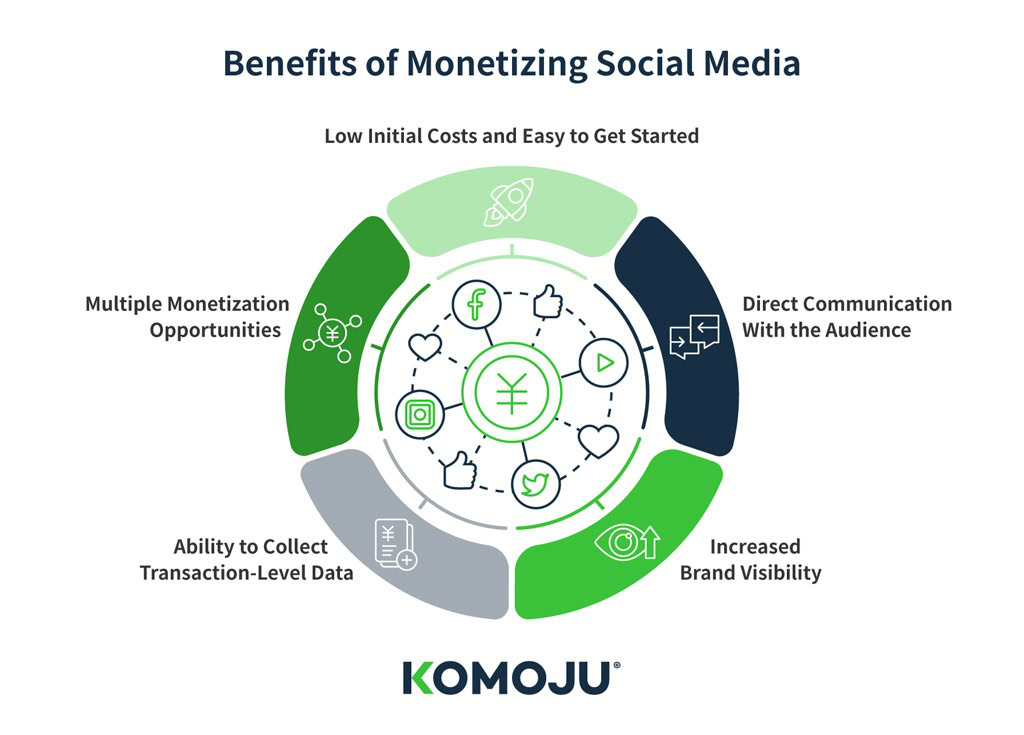
Low Initial Costs and Easy to Get Started
Monetizing through social media typically requires minimal upfront investment. Publishing content is free, and most options build on tools creators are already using.
- No storefront or inventory system is required to begin.
- Platform monetization programs do not charge entry fees.
- Direct selling methods can work without an eCommerce website.
The trade-off is that access to some revenue streams is gated by eligibility requirements, and income is not guaranteed early on.
The low barrier to entry is one reason social monetization has scaled. Meta reports that more than 200 million businesses globally use Facebook and Instagram tools each month to reach customers. This reflects how common selling on social media has become.
Direct Communication With the Audience
More and more people are using social media the way they previously used Google. This is already true for close to half of consumers, and even more so for Gen Z when researching brands and products.
Social media allows creators to sell directly to people who already engage with their content, so growth isn’t driven by ads alone.
- Monetization happens where audiences already interact.
- Direct sales reduce dependence on intermediaries.
- Feedback and demand signals are faster and more visible.
This direct channel is one reason many creators move beyond platform-only monetization.
Increased Brand Visibility
Platforms tend to reward consistent posting, engagement, and creator-led commerce with additional reach.
- Sponsored posts and affiliate links integrate products into content.
- Platform programs encourage regular publishing and audience growth.
- Selling directly can strengthen brand recognition over time.
Visibility, however, remains subject to algorithm changes and platform priorities.
Ability to Collect Transaction-Level Data
Platform-run monetization limits what creators can see about their audience. Direct monetization provides clearer signals about what people are willing to pay for.
- Access to order confirmations and purchase history.
- Better insight into pricing, demand, and repeat customers.
- Greater responsibility for handling data appropriately.
This data is often basic, but it is more actionable than engagement metrics alone.
Multiple Monetization Opportunities
In 2022, Adobe reported that nearly half of online creators in the US see themselves as small business owners, which helps explain why diversified income streams are common. They are managing revenue, pricing, and customer relationships, not just publishing content.
- Platform programs can provide a baseline income.
- Direct sales offer higher control and flexibility.
- Diversification helps offset policy changes and payout volatility.
Using multiple monetization methods is less about maximizing earnings and more about maintaining stability.
How to Monetize Social Media
There is no single formula for monetizing social media. Most creators and small businesses combine several methods over time.
Ad Revenue (Platform-Based Advertising)
Ad revenue is when a platform places ads on or around your content and shares a portion of that income with you. For most creators, it works best as a supplementary stream.
However, earnings are tied to view volume and advertiser demand. This makes revenue uneven unless a channel reaches significant scale.
Where ad revenue works best:
- Long-lasting content that continues to attract views (tutorials, how-tos, explainers, etc).
- Product comparison content that targets high-intent search and “research” viewers.
- Evergreen niche topics that bring steady traffic rather than spikes.
Premium Content and Paid Subscriptions
Premium content is content customers pay for, usually through subscriptions or a paid community.
In practice, this often runs through platforms such as Patreon, YouTube channel memberships, Instagram subscriptions, or fan-funding platforms like Fansly. Creators and small businesses gate tutorials, behind-the-scenes content, early access, or private livestreams.
Premium content ideas that work for merchants:
- Members-only tutorials, guides, or routines tied to what you sell.
- Early access to new drops and limited items.
- Exclusive discounts or bundle offers for subscribers.
- Private Q&A sessions or office hours.
- Community access, feedback threads, and accountability groups.
Affiliate Marketing on Social Platforms
Affiliate marketing is a performance-based model where creators or partners promote a product and earn a commission when they drive a sale or a qualified lead. For online sellers, it is practical because cost is tied to results rather than upfront spend.
Good affiliate partner types:
- Creators in your niche who already review or recommend products like yours.
- Bloggers and newsletter owners with high-intent audiences.
- Communities and comparison sites that influence purchase decisions.
- Service providers or agencies that can refer clients to your product or offer.
Sponsored Posts
Sponsored posts are paid collaborations in which a creator features a product to their audience, usually in their own style. The practical approach is to treat sponsorships as both distribution and creative production, not a one-off post.
Best uses for sponsorships:
- Launches and new product releases.
- Products are best explained through demonstration.
- Brand awareness in a tightly defined niche.
- Seasonal pushes when you have clear timing and urgency.
Online Live Events
Online live events let you sell in real time through live demos, workshops, launches, and time-limited deals. The main benefits are clearly showing the product, answering questions in real time, and reducing hesitation at the point of purchase.
However, live events carry operational risks. Technical problems, timing issues, or missteps can happen in real time with limited ability to correct them.
Live formats that merchants can use:
- Live product demos with real Q&A.
- Launch events with limited bundles or timed bonuses.
- Paid workshops that teach a skill tied to your product.
- Expert interviews or panels for credibility and reach.
- Drop-style events for limited inventory and hype.
Selling Physical and Digital Products
Selling your own products is the most direct way to turn social media attention into revenue. The main goal should be to shorten the customer’s path from “I want this” to “I paid for it.”
Nearly 48% of social media users have made an impulse purchase after seeing a product on a social platform. In many cases, spending goes well beyond low-cost items.
- Selling Handmade and Physical Products
Handmade and small-batch products perform well on social media because their products and processes can be shown clearly. - Selling Online Courses and Digital Products
Courses and digital products sell when the offer is concrete, and delivery is simple. Many creators separate social distribution from payment and delivery to keep pricing control and stay flexible as they refine the offer.
If you want to sell without directing buyers to a marketplace listing, a payment link can work as a faster checkout step from a post, story, or DM.
More recent coverage suggests AI-driven shopping adds an important second layer. While traffic from AI tools and automated recommendations is still relatively small, retailers report that these users arrive with high purchase intent.
Together, these trends point to the same takeaway: complexity will stall a sale.
Accept Payments on Social Media Using KOMOJU Payment Links
You can start selling without a full eCommerce site. KOMOJU Payment Links let you create a standalone checkout page and share it in your bio, stories, posts, pinned comments, or DMs, giving buyers a faster path from interest to payment.
Platform | What it’s best for | Main monetization paths | How people usually get paid | Good fit for |
Visual products and services | Affiliates, brand deals, direct sales | Links in bio, stories, DMs | Retailers, makers, and local services | |
TikTok | Fast reach and impulse buying | Creator programs, live gifts, brand deals | Profile links, pinned comments | Product launches, drops |
YouTube | Showcasing expertise and how-tos | Ads, memberships, fan support, product/service sales | Video descriptions, memberships | Courses, consulting, reviews |
X (formerly Twitter) | Authority and conversation | Subscriptions, affiliates, direct sales | Profile links, posts | Writers, consultants, SaaS |
Merchants widely use Instagram to sell physical products and services, especially where visuals and trust drive sales. Meta has invested “hundreds of millions” of dollars to support creators. These efforts further enhance the potential for sales and monetization on Instagram.
- Strong visual formats for clearly showing products.
- Ongoing engagement through stories and reels.
- Natural fit for showcasing work, results, and portfolios.
Scale and usage
- Meta reports that over 200 million businesses use Facebook and Instagram tools every month to reach customers.
- Likewise, more than 2 billion people use Instagram’s shopping-related features monthly.
Instagram supports in-app shopping, but many sellers still rely on external payment flows for services, limited drops, or off-platform fulfillment.
TikTok
One estimate puts total TikTok creator earnings at $4.1 billion in 2024, but reports that 62% of creators use multiple revenue streams.
TikTok is built around momentum. Sales often spike quickly, but income can be uneven.
- Content reaches new audiences quickly.
- Works well for demos and before-and-after content.
- Strong for impulse-driven products.
How Selling Usually Works
TikTok’s built-in monetization tools are eligibility-based and change over time. Many merchants use TikTok to generate interest, then direct buyers to an external checkout to complete the purchase or sell directly within TikTok using TikTok Shop.
YouTube
The YouTube Partner Program has grown to more than 3 million channels, and YouTube has paid creators over $107 billion.
YouTube works best when products or services need explanation. Content lasts longer here, which makes it useful for selling higher-consideration items.
- Videos stay searchable and relevant over time.
- Strong fit for tutorials, reviews, and detailed explanations.
- Better suited to building trust before a purchase.
How selling usually works:
YouTube offers ad revenue and memberships, but many merchants treat the platform primarily as a discovery and education channel. Sales typically happen through links in video descriptions or pinned comments rather than inside the platform itself.
X
X (formerly Twitter) works best when the product is tied to expertise, opinion, or ongoing commentary. It’s less about visuals and more about credibility.
- Easy to build visibility through replies and reposts.
- Works well for niche audiences and thought leadership.
- Low production overhead compared to video platforms.
How selling usually works:
X offers subscriptions and ad revenue sharing, but these programs have eligibility requirements and are not the primary sales path for most merchants. Instead, sellers typically use posts and profiles to direct buyers to an external checkout for services or digital products.
Tips for Successful Social Media Monetization
A lot of people try to monetize, get decent engagement, and still don’t see sales. Often it’s not the product. It’s the path to purchase. If the buying step feels awkward or confusing on that platform, people drop off. Customer experience research consistently points to ease and trust as major drivers of follow-through.
A simple way to keep things aligned is to plan backward from the buyer’s perspective:
Audience → Platform → Offer → Payment
Before you commit to a platform or feature, answer these:
- Who is my buyer in one sentence?
- What are they trying to accomplish or solve?
- What do they already pay for in this category?
- Where do they actually interact with sellers like me?
- What usually makes them hesitate right before paying?
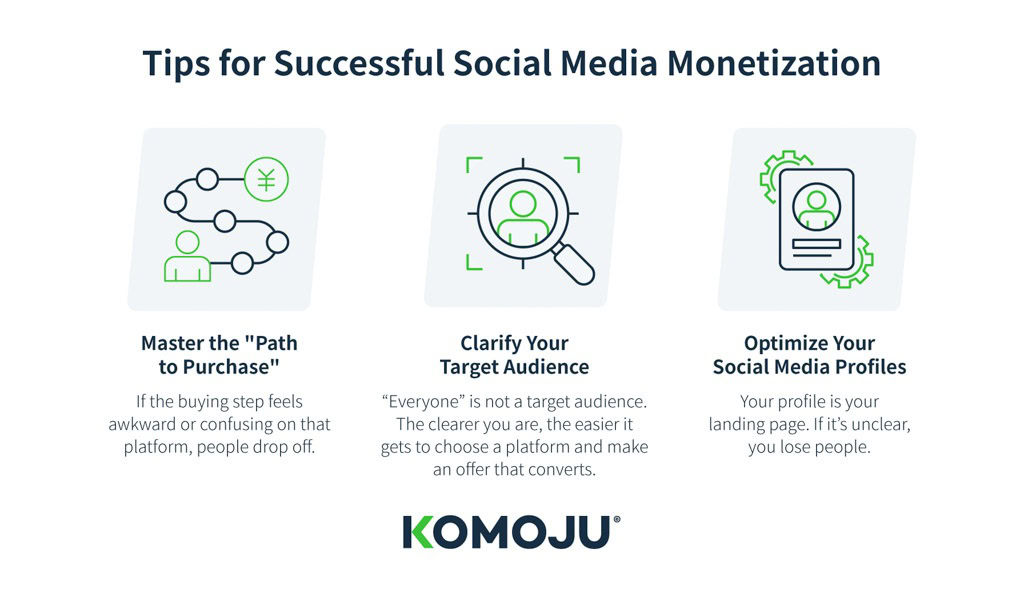
Clarify Your Target Audience
“Everyone” is not a target audience. The clearer you are, the easier it gets to choose a platform and make an offer that converts.
A simple way to define it:
- Buyer type: For example, hobby learners, busy parents, and small business owners.
- Buying trigger: What makes them consider buying now?
- Main hesitation: Price, trust, timing, complexity.
- What convinces them: Reviews, examples, before-and-after, guarantees, credentials.
It’s also important to stay aware of where attention is moving next. Platforms like Discord are increasingly used as private community hubs, and newer networks like Threads and Bluesky are still upcoming.
Optimize Your Social Media Profiles
Your profile is your landing page. If it’s unclear, you lose people.
Quick profile checklist
- Say what you sell and who it’s for in the first line.
- Show proof fast: Results, examples, testimonials, case photos.
- Make the next step obvious: One main link and one clear instruction.
- Pin one post that explains what to buy and how to buy.
- Keep contact and business details current.
Sell Products on Social Media Without an eCommerce Site
Not every merchant needs a full online store. In many cases, social media already does the heavy lifting for discovery and trust. What’s missing is a simple way to get paid.
Payment links solve that gap. They create a standalone checkout page that you can share directly in a bio, post, story, pinned comment, or DM. Buyers click the link, choose a payment method, and complete the purchase without being redirected through a full eCommerce flow.
KOMOJU Payment Links are designed for this kind of social-first selling and work even if you don’t have a website.
Use Case: Selling Through Social Media Without a Website
Many small businesses in Japan use social media alongside their storefronts to confirm orders and close sales. Payment links fit naturally into this flow by allowing merchants to move from discussion to payment at the right moment, without redirecting customers to a full eCommerce site.
Across social platforms, payment links are commonly used by:
- Handmade sellers sharing limited-run items through posts or stories.
- Repair and local service providers confirm the price by message, then send a payment request.
- Educators and creators collect monthly fees for lessons, courses, or memberships.
Because the checkout is mobile-friendly and hosted, customers can pay immediately using familiar payment methods, without creating accounts or navigating a store.
Summary | Key Takeaways for Social Media Monetization
Social media monetization works best when it is treated as a sales channel, not just a content platform. The strongest results come from aligning three things:
- The audience you reach
- The platform you use
- How easily can people pay
For merchants or service providers, social media works best as a demand and trust engine, while checkout is usually better kept simple.
Direct monetization through products, services, and subscriptions gives you more control and tends to be more predictable. Monetization works when your setup matches how customers discover, decide, and pay. When the platform, content, and payment step line up, social media becomes a repeatable revenue channel.
FAQ
The main options are platform programs (ads, subscriptions, tips) and direct monetization (selling products or services, affiliate links, sponsored posts, paid events).
Use social posts or DMs to create interest and confirm details, then send a payment link so the customer can pay on a hosted checkout page.
You set up a payment link through your payment provider’s dashboard.
Once the link is generated, you share it with customers through a bio link, post, story, or direct message. When someone clicks the link, they complete payment on a secure checkout page, and you receive a confirmation.
We help businesses accept payments online.