WooCommerce in Japan: Payments, Localization and KOMOJU
Table of Contents

We help businesses accept payments online.
WooCommerce is an open-source plugin that turns WordPress into an eCommerce store, and it is powering millions of online businesses worldwide. In Japan, it becomes even more powerful when paired with KOMOJU, which lets merchants offer the payment methods shoppers actually use—credit cards, PayPay, Konbini payment, bank transfers, and carrier billing. Together, WooCommerce and KOMOJU create a checkout that feels familiar to Japanese consumers and makes it easier for merchants to convert sales.
Japan’s B2C eCommerce market hit ¥24.8 trillion in 2023, a 9.2% increase from the year before—and it’s still growing. Cashless payments remain relatively low at 42.8%, but adoption has sped up since METI launched its “Cashless Vision” in 2018. Shoppers are also mobile-first: 71% now buy online with their smartphones, driving the rise of QR-code* wallets, which accounted for 9.6% of cashless spending in 2024.
This article explores why WooCommerce, when paired with KOMOJU, offers a strong alternative to platforms like Shopify in Japan. It highlights WooCommerce’s fit for the local market, explains how payment localization boosts conversion, and shows how KOMOJU helps merchants meet shopper expectations while addressing challenges such as performance, plugin gaps, and transaction security.
WooCommerce in Japan: Context and Global Reach
WooCommerce’s appeal lies in its flexibility. Merchants can customize stores with themes, plugins, and APIs, while controlling hosting, costs, and site performance. This independence comes with responsibility—security, updates, and compliance all fall on the merchant.
Still, WooCommerce benefits from the massive WordPress ecosystem: 43% of all websites use WordPress, and the WooCommerce plugin itself has more than 7 million active installations.
WooCommerce’s own guidance recommends secure payment gateways and SSL certificates to protect customer card data—it never stores card numbers itself.
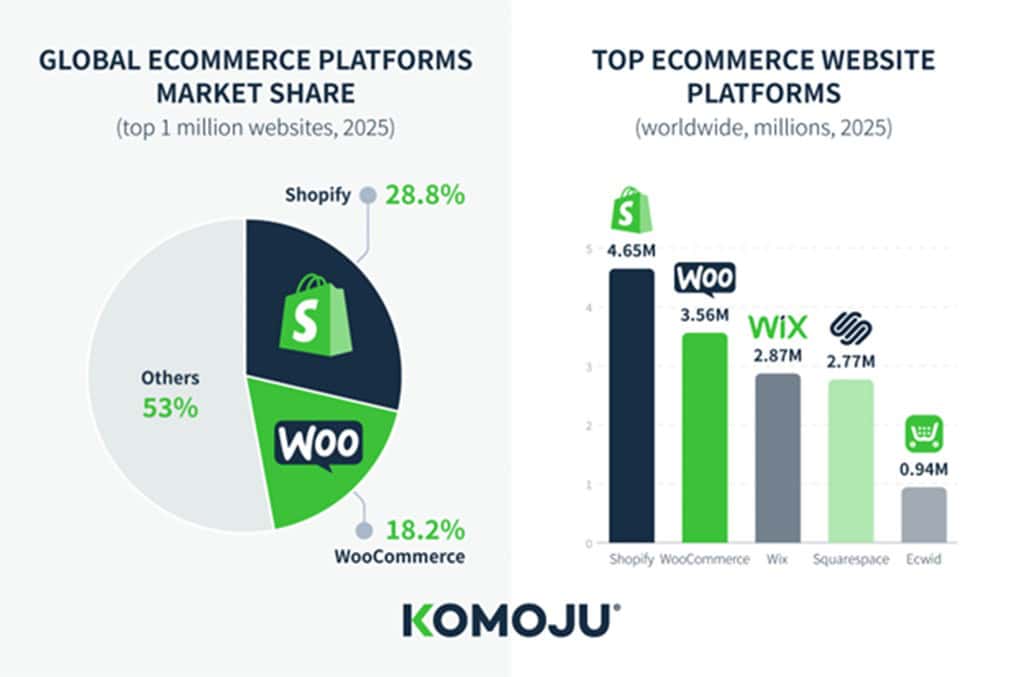
Global Adoption—WooCommerce Vs. Shopify
20% of online stores worldwide, while Shopify, at 4.65 million websites, accounts for approximately 26%. Together, they dominate the global eCommerce market.
Shopify is more common among high-traffic, enterprise-level sites, while WooCommerce is popular with small and mid-sized businesses. Its close integration with WordPress makes it attractive for merchants who want control over content, SEO, and store customization in one place.
WooCommerce Strengths: Flexibility, Open Source, and Cost
What sets WooCommerce apart is control. Unlike hosted platforms, merchants can adjust checkout flows, product listings, and integrations as they need. In Japan, this means adding features shoppers expect—like furigana name fields or delivery time slots—while also maintaining stronger SEO and full ownership of business data.
Content + SEO on WordPress
WooCommerce runs on WordPress, so merchants get a complete CMS and SEO stack (like Yoast) in the same place—clean URLs, editable titles and meta, structured data (schema), XML sitemaps, and a blog on the same domain. It’s also easy to publish in Japanese and link content to products, which supports organic discovery and builds trust amongst new customers.
Checkout Control
WooCommerce gives merchants complete control over checkout. Fields can be added, removed, renamed, reordered, and validated, and the sequence of steps can be adjusted with plugins or custom code. Shopify restricts edits to its core checkout steps to Shopify Plus, while standard plans allow branding and a limited set of extension points.
For Japan, this control makes it straightforward to add phonetic name fields, postal code–to–address autofill, delivery date/time selection, and required legal disclosures within the checkout flow.
Catalog Flexibility
WooCommerce doesn’t cap product options or variants. Shopify, by comparison, restricts products to three options and 100 variants (with workarounds or apps needed for more). For merchants selling apparel, electronics, or multi-SKU food items, WooCommerce provides far more flexibility out of the box.
APIs and Integrations
WooCommerce includes an API that lets merchants connect their store to inventory, analytics, or even custom apps. This makes it straightforward for merchants to connect to ERP/OMS systems, run analytics, or even build headless commerce solutions.
This level of access is particularly beneficial for merchants in Japan who are balancing online and offline inventory because it allows stock levels to update in real time across channels.
WooCommerce’s API makes it easy to connect with POS or ERP systems. For example, the Square for WooCommerce plugin syncs in-store sales to the online store, so stock updates in real time.
That prevents overselling, keeps delivery promises accurate, and supports Japan-specific practices such as offering customers precise delivery dates and time slots (standard in Japanese logistics, e.g., Yamato’s time-slot delivery system).
Data Ownership & Portability
Because WooCommerce is open source, merchants have complete control over their data. Product and order data can be exported directly using the built-in Product CSV Exporter or through premium tools like Customer/Order/Coupon Export. Merchants can back up or move their entire store easily with WordPress’s export tools.
By contrast, Shopify is a hosted SaaS platform: merchants remain the controllers of their customer data, but Shopify stores and processes it on its own servers, primarily in Canada and the U.S., with transfers to other regions as needed (Shopify Privacy Policy). While exports are available through Shopify’s admin or APIs, merchants do not have direct access to the underlying database.
In Japan, regulations like the Act on the Protection of Personal Information (APPI) require long-term retention, auditability, and often in-country storage. WooCommerce’s open-source model supports this by allowing businesses to host data domestically and set their own retention and compliance rules.
Cost Model
WooCommerce doesn’t charge platform transaction fees—merchants pay only payment gateway fees and hosting/operations. Shopify, on the other hand, adds third-party transaction fees when merchants don’t use Shopify Payments: 2.0% on Basic, 1.0% on Grow, and 0.6% on Advanced.
For businesses running on slim margins or requiring local payments (e.g., PayPay, Konbini payment, carrier billing), WooCommerce can be more economical because these gateways can be integrated without a platform surcharge.

Japan’s eCommerce Market
Japan’s eCommerce market is one of the most advanced globally, underpinned by high internet penetration (88.2% of the population were internet users in 2025) and a sophisticated logistics network where next-day delivery is the standard even between major cities (e.g., Tokyo to Osaka in one day, Hokkaido to Okinawa within two days).
This environment has created a digitally savvy and demanding consumer base. Shoppers expect seamless mobile experiences, fast fulfillment, and dependable service.
The opportunity for merchants is clear, but so are the stakes. To succeed, they must meet expectations around speed, mobile usability, brand trust, and localized payment options at checkout.
Consumer Expect Speedy Delivery
Speedy fulfillment is the baseline in Japan. In a survey by the Japanese marketing research site ecnomikata.com, 70% of online shoppers say delivery speed is a crucial factor. Next-day shipping is widely expected thanks to carriers like Yamato, Sagawa, and Japan Post, who have long set the standard for fast, reliable delivery. Delays beyond three days make shoppers uneasy, and nearly 40% have abandoned a purchase because the estimated delivery felt too slow.
Alongside high shipping costs, unclear delivery dates, and late arrivals are among the leading causes of cart abandonment. For merchants, this means logistics speed and clear communication about delivery times are essential to winning and keeping customers.
Mobile Shopping in Japan
Mobile shopping is now the norm in Japan. In 2023, 58.7% of all online retail purchases were made on smartphones. A separate survey of 1,000 Japanese consumers found that 71% shop online with their phones, with exceptionally high usage among women in their 30s and 40s—two out of three prefer mobile shopping.
For merchants, mobile optimization is essential. Shoppers may prefer apps for rewards and repeat purchases, but the mobile web is still key for discovery. Both need to work smoothly.
Friction at checkout is costly: even a one-second delay in page load can reduce conversions by 7% (Akamai/BigCommerce), and Google data shows the impact is even sharper on mobile—up to 20% of conversions lost per second of delay. In a market where speed and reliability are cultural expectations, delivering a fast and polished mobile checkout is critical.
Building Trust in Japanese eCommerce
Japanese consumers value trust as much as speed. Giants like Amazon Japan and Rakuten thrive on reliability and buyer protection, but smaller brands can win if trust signals are strong.
According to Itsumo’s 2024 survey of 1,675 shoppers, unclear return policies and vague product descriptions are prevailing barriers, while positive reviews and clear site design drive purchase decisions.
Generational patterns also matter: shoppers in their 20s rely more on Amazon, while older demographics lean toward Rakuten. Across age groups, reviews are decisive—76.8% of consumers say they reference product reviews before buying. Understanding these generational differences, and their payment preferences, is a key decision when entering the Japanese market.
Merchants in Japan need strong websites, visible reviews, and responsive customer support to earn loyalty.
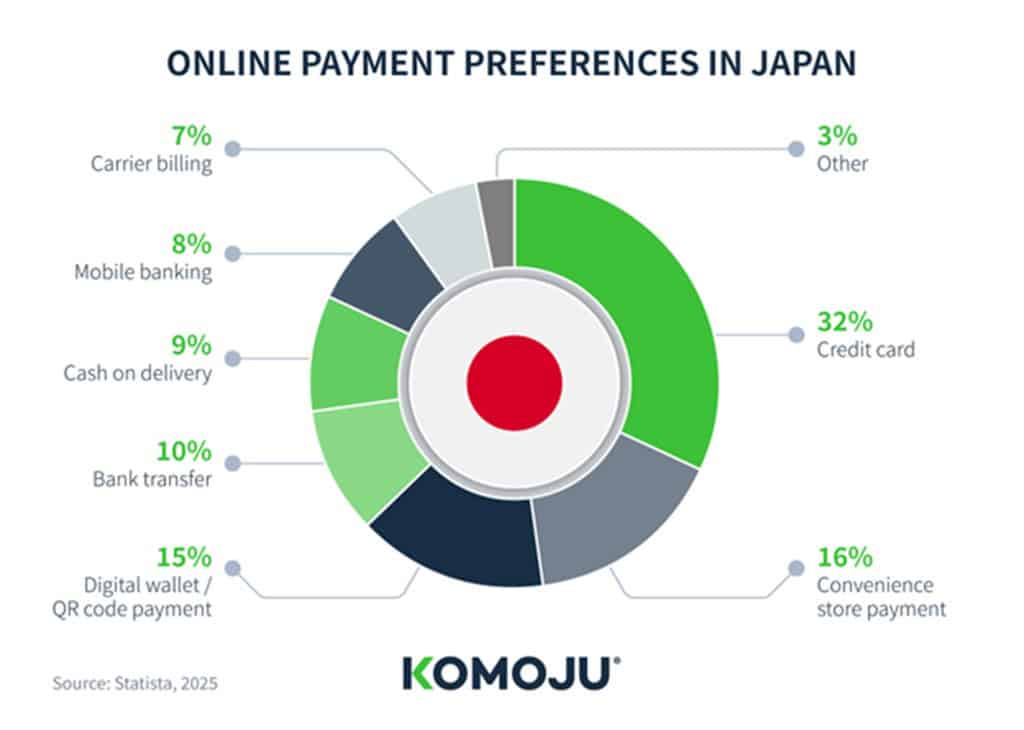
Checkout success in Japan often hinges on choice. Credit cards still lead, but wallets like PayPay are rising fast, Konbini payment remains vital for cash users, and BNPL is gaining ground. With KOMOJU, merchants can offer all of these in WooCommerce, meeting local expectations and reducing cart abandonment.
Credit Cards: Still Leading but Declining
Credit cards remain the most widely used online payment method in Japan, making up approximately 32% of eCommerce transactions by volume in 2024. They’ve held the top spot for over a decade, thanks to convenience, rewards programs, and near-universal acceptance across platforms like Amazon Japan, Rakuten, and Yahoo! Shopping.
However, their share is slipping as younger shoppers embrace wallets like PayPay and Rakuten Pay. The takeaway is that credit cards remain essential, but relying on them alone is risky. Japanese consumers expect choice.
PayPay and Mobile Wallets: Rapid Growth
As of 2023, digital wallets made up about 15% of transaction volume in Japan. Looking beyond online shopping to all payment activity, wallets like PayPay and Rakuten Pay captured roughly 35% of the overall market, compared to 45% for cards and 20% for cash.
Within this segment, PayPay stands out as the clear leader. By 2025, the app had surpassed 70 million active users and now accounts for roughly one in every five cashless transactions nationwide.
Konbini Payments: Still Relevant
Konbini (convenience store) payments may feel old-fashioned compared to QR-code* wallets, but they remain a fixture in Japanese eCommerce. Even in 2025, around 15% of transactions are still completed via Konbini pay. With more than 56,000 convenience stores nationwide, this method is available almost everywhere, making it a lifeline for shoppers who prefer cash or don’t have a credit card.
BNPL: Emerging and Growing
Buy Now, Pay Later (BNPL), or 後払い決済 (atobarai), still constitute a small percentage of the market but is expanding fast. Services like Paidy (PayPal-owned), Klarna, and Merpay are popular across age groups. The market is projected to grow 33.7% in 2025 to US $20.1 billion, and could reach US $58.3 billion by 2030.
WooCommerce Challenges in Japan (Hosting, Plugins, Security)
Hosting, Speed, SSL
WooCommerce is self-hosted, so merchants must manage hosting, SSL, and site speed themselves. In Japan, where shoppers expect near-instant load times, weak hosting or poor optimization can hurt conversion. Shopify or BASE bundle this in, but WooCommerce requires merchants to invest in solid infrastructure.
Plugin Availability
WooCommerce offers thousands of plugins, but Japan-specific tools are limited. The free “Japanized for WooCommerce” plugin link adds basics like Japanese address formats, furigana name fields, and invoice emails.
Beyond that, gaps remain: few shipping plugins work directly with Yamato or Sagawa, and Japan’s new Qualified Invoice rules often require extra setup with third-party add-ons. Compared to Shopify, which has more Japan-ready apps, WooCommerce takes more work to localize.
Security Responsibility
Open source means flexibility and responsibility. WooCommerce merchants must manage hosting, updates, and site security themselves. In Japan, trust is closely linked to security, and neglecting it can damage your brand. The good news: KOMOJU lifts the burden of complex payment security from merchants.
As a PCI DSS compliant provider, KOMOJU manages the entire payment security layer, ensuring merchants never touch sensitive card data. While merchants are always responsible for general security best practices, with KOMOJU they are able to focus on the business of their store, not on payment security issues and compliance audits.
Payments Localization
WooCommerce doesn’t natively support key Japanese payment methods like PayPay, Konbini pay, or carrier billing via WooPayments (merchants can enable some of them using third-party plugins).

Thankfully, KOMOJU solves this, giving WooCommerce merchants plug-and-play access to preferred payment methods in Japan and making checkout fully localized.
WooCommerce and KOMOJU: Case Study (KOMODO in Japan)
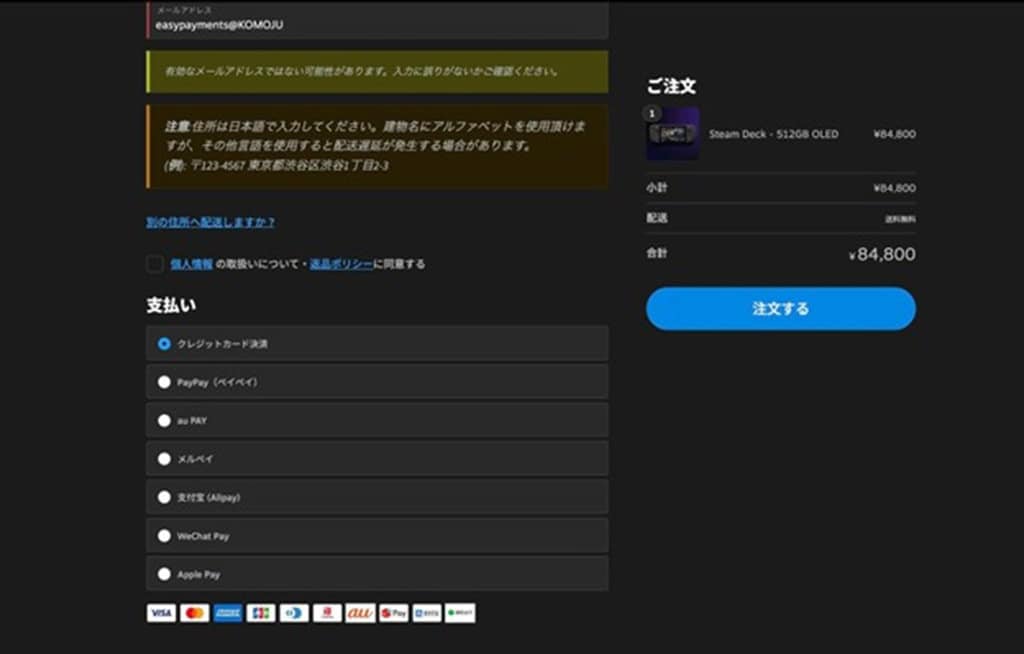
A real-world example of WooCommerce and KOMOJU working in Japan comes from KOMODO, the official distributor of the Steam Deck in Asia. For the Japan launch, KOMODO needed to sell high-demand hardware through its own site, while meeting local consumer expectations for checkout.
By integrating WooCommerce for storefront control and KOMOJU for payments, KOMODO was able to:
- Offer localized methods like JCB, Konbini pay, PayPay, and carrier billing—all of which Japanese consumers expect.
- Manage surging order volume during launch without checkout bottlenecks.
- Ensure compliance and trust: KOMOJU handled PCI DSS security, while WooCommerce gave KOMODO complete control of site performance and branding.
The result was a localized, scalable checkout that matched Japanese consumer habits while keeping KOMODO’s operations in-house.
WooCommerce in Japan: Future Outlook and Key Takeaways
WooCommerce’s open-source flexibility is a strength, but it also means merchants handle more themselves. Hosting, site speed, plugins, and meeting Japan’s regulations all take extra work, which can make WooCommerce look complicated compared to ready-made Shopify. However, when properly localized, WooCommerce gives merchants lower costs, complete control of their data, and the freedom to customize checkout exactly as they need.
KOMOJU makes WooCommerce checkout feel local in Japan. With a single integration, merchants can offer credit cards, PayPay, Konbini pay, carrier billing, and BNPL—without the hassle of juggling multiple plugins. The result is a checkout that meets Japanese shopper expectations and makes WooCommerce a stronger fit for the market.
In Japan, success will come to merchants who combine global best practices with local expectations. WooCommerce, paired with KOMOJU, is positioned to meet that need: an adaptable, cost-efficient platform aligned with Japanese consumer behavior and built for long-term growth.
Discover how easily KOMOJU can power your WooCommerce store in Japan’s fast-growing eCommerce market.
*QR Code is a registered trademark of DENSO WAVE INCORPORATED in Japan and in other countries.
We help businesses accept payments online.