
We help businesses accept payments online.
If you’ve already launched in the US or Europe, starting to sell online in Asia often feels like the obvious next move, but understanding Asia payment methods can feel complex.
After all, Japan is the world’s fourth-largest eCommerce market, sitting at roughly $250 billion every year and still growing at 7–11%. Southeast Asia’s digital economy passed $300 billion in 2025. And South Korea has one of the highest rates of mobile eCommerce adoption anywhere in the world.
And despite the reputation for being impenetrable to foreign merchants, international brands are booming across Asia.
Louis Vuitton, Costco, IKEA and Zara are all growing fast in Japan. In Korea, the country that exports K-beauty products around the world, foreign beauty and skincare brands actually dominate around 60% of the premium skincare market, with Chanel, Moroccanoil and CeraVe on Olive Young’s shelves next to the K-beauty products.
And across Southeast Asia, Nike, Adidas and Decathlon are among the best-selling international brands on Shopee, Lazada and Coupang in Korea.
So demand isn’t the problem. Brands don’t struggle in Asia because nobody wants to buy what they’re selling. They stall because accepting Asian payments is a lot more complex than accepting payments for Europe and the USA.
So, we’re going to break down some of the big misconceptions about selling to Asia and how you can adapt your store to start selling to the next hot global market.
Is Asia one big market? Or is that a big misconception?
Ask anyone who’s expanded into Asia and they’ll tell you that Asia isn’t a single market. Read any article about launching in Asia and you’ll find the same thing.
And it’s true. While Japan, Thailand and Korea are neighbors, at the checkout they’ve got about as much in common as Germany, Italy and Sweden, three European neighbors that each pay in completely different ways.
But it’s more than that, too.
If it was just about accepting different currencies, the fix would be easy: swap the payment currency country by country, translate the page, move on.
However, for most Asian countries, the way they choose to pay online is dictated by nuanced, centuries-long traditions, culture, history and attitudes towards money. It’s far more complex than the West’s approach to payments.
And that’s the part that’s hard to see from outside the market, because for most Western customers, a card is a card. Our payment methods aren’t personal or tied to tradition.
But in Japan, payment methods are tied up with how people feel about debt and about trust. Around 70% of Japanese shoppers own a credit card, but not paying it off in full has a cultural weight and shame to it that easy Western borrowing doesn’t, so someone with a perfectly good card will still reach for a way to pay that doesn’t feel like debt. Cash has a practical logic too: it still works when an earthquake takes the power out. As such, pre-paid, cash and bank transfer payment methods are incredibly popular in Japan.
(For more information on Japan’s unique payment culture, read our in-depth breakdown.)
In Korea, it’s about the apps that customers already use. Naver Pay is hugely popular in Korea because it sits inside Naver’s shopping ecosystem. Kakao Pay works the same way: it lives inside KakaoTalk, the messaging app nearly every Korean adult opens every day.
Across Southeast Asia, it comes down to access. A credit card needs a bank account, a documented income and a credit history, and with more than 70% of adults unbanked or underbanked, that’s an issue. But getting a smartphone doesn’t require as much documentation, so mobile payments have boomed. In fact, mobile penetration passed 90% while card ownership stalled below 10% in most of the region.
This is why retail in Asia was considered fragmented and closed to foreign merchants for decades and why that criticism was wrong: foreign brands do really well here, as long as they’re willing to understand the market and adapt to it.
What local payment methods do you need to sell in Japan?
Adapting to Japan's diverse landscape of konbini, bank transfers, digital wallets and QR code* payments.
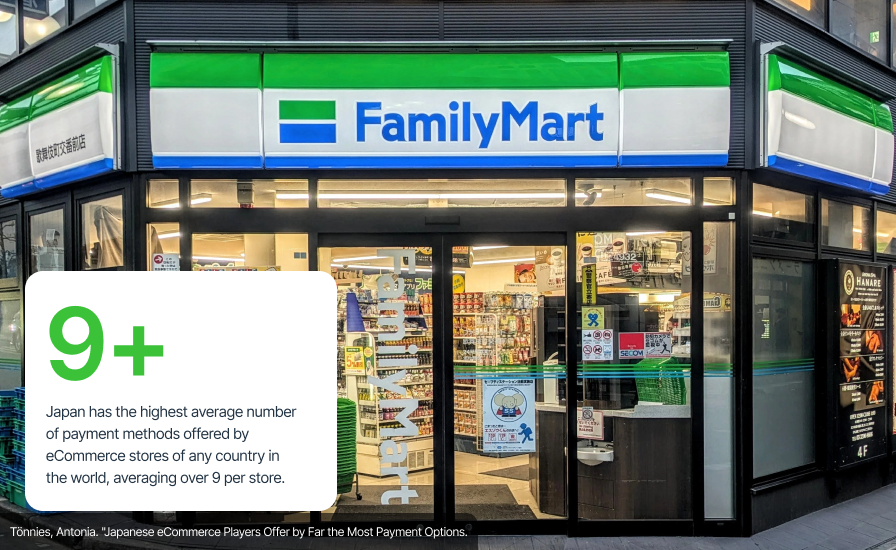
Japanese eCommerce stores offer more payment options than stores anywhere else on earth, nine or more on average, whereas most Western stores offer just four or five.
That sounds complex – and it is, a little – until you understand that each of those methods exists because it solves or addresses something specific about how people here relate to money, and those attitudes don’t have close Western equivalents.
Let’s start with cash, for example. Japan’s cash-to-GDP ratio sits around 20%, against 8% in the US and under 1% in Sweden.
There’s even a word for money kept at home rather than in a bank — tansu yokin, savings in the chest of drawers — and research suggests that around half the currency in circulation isn’t circulating at all, but sitting in people’s houses.
Some of that is practical, because in an earthquake-prone country, cash still works if the power is out. But most of it is a long-standing relationship with cash as something tangible, safe and entirely within your own control.
There’s also a culture and tradition around debt too. Around 70% of Japanese consumers hold a credit card, marginally more than in the US, but average card debt is far lower because revolving credit is rare. In Japan, cards get paid off in full every month. And that’s because debt here carries a cultural weight — historically tied to shame — that changes how people spend their money.
*QR Code is a registered trademark of DENSO WAVE INCORPORATED in Japan and in other countries.
How Japan’s unique digital payments landscape has adapted to its culture
Each of Japan’s payment methods exists as a response to a particular nuance of Japanese culture, tradition and attitudes towards money. It’s about trust in cash, the discomfort with debt, or the wariness about handing card details to a website.
Konbini is the clearest example. A shopper orders online, then walks to a convenience store and pays in cash. From outside Japan, that sounds like a workaround for people without cards. It’s the opposite. It’s chosen by people who have a card and would rather not put it into a site they don’t know yet so choose to pay cash instead. In fact, letting Japanese customers pay cash for your eCommerce products can lift eCommerce conversion by up to 27%.
PayPay addresses the Japanese attitude towards debt. Someone loads it with money and spends from that balance. Functionally, it works like a credit card, but there’s no revolving credit and nothing that resembles borrowing. That matters in Japan because carrying a balance here still carries a cultural weight most Western card users never think about. PayPay gives people the convenience of paying digitally without any of that weight attached. It passed 70 million registered users in 2025, which is more than one in two people in the country.
Bank transfer (furikomi), usually handled through Pay-easy, solves the same fraud-anxiety problem konbini does, but for higher-value orders. Pay-easy lets customers move money straight from their account to yours, with no card exposed at any point. Since around 98% of Japan’s population has a bank account, it reaches almost everyone, and it’s the method Japanese shoppers reach for when the order is too large to risk on an unfamiliar checkout.
JCB is Japan’s only home-grown card network, founded in Tokyo in 1961 and woven into the country’s banking and points infrastructure for over six decades. Plenty of Japanese shoppers carry one as their main card precisely because it isn’t a foreign brand and they’ve spent decades building up trust. However, it’s rarely enabled by default outside Japan.
Carrier billing was built for shoppers who don’t have a credit card at all, usually because they’re too young to qualify for one. Japan’s mobile carriers have spent decades turning themselves into something closer to banks than phone networks — NTT Docomo alone has over 80 million subscribers and runs its own points programme — so putting a purchase on the phone bill is a natural, trusted way to pay for people who’ve never held a card.
Rakuten Pay lets you tap into another quirk of the Japanese market: points. Points aren’t a loyalty perk here, they’re closer to a second currency, used across more than 70 services by nearly 60% of the country. Japanese shoppers factor in what they’ll earn before they’ve even chosen a product, sometimes even deciding where to buy based on it.
That’s what’s so interesting and exciting about Japan as a market. While there are things like Klarna in the West that are about attitudes towards spending, there’s no cultural and emotional difference between Visa and Mastercard for Western shoppers.
In Japan, the payment method you use is personal and tied in decades – centuries, even – of tradition and national culture.
(Our full guide to entering Japan’s eCommerce market goes deeper on everything here.)
How do they pay online in South Korea? Are credit cards still king?
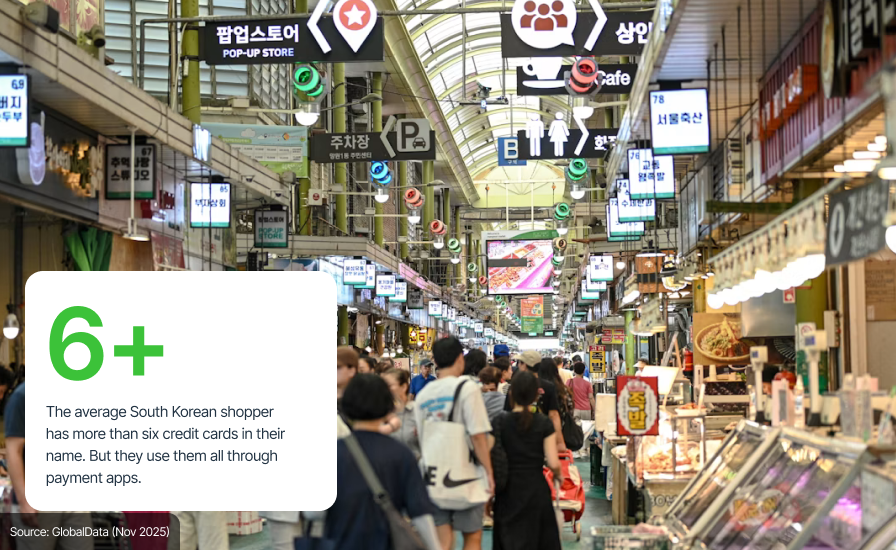
From the outside, Korea looks like it should follow the same logic as Japan or Southeast Asia: credit cards are missing or distrusted, so wallets fill the gap.
But it’s actually the complete opposite.
After the 1997 Asian financial crisis, the Korean government pushed hard to get cards into circulation. They offered tax rebates on card spending, made it a legal requirement for retailers to accept credit cards and even ran a lottery with cash prizes for every card transaction.
And it worked.
Within a few years, nearly half of all purchases in Korea were with a card, and today it’s around 70%, with the average person carrying close to seven credit cards.
The problem? Paying online.
For close to twenty years, buying something online in Korea with a card meant installing a browser plugin called ActiveX — which only worked in Internet Explorer — then downloading a government-issued digital certificate, then typing a password packed with special characters before you could make the payment.
Worse, you had to do it on every new device, and the certificate itself became a target for phishing.
And it was so restrictive that foreign shoppers were routinely locked out completely. Famously, Chinese fans of a hit Korean drama couldn’t buy the clothes its lead actress wore, because getting an accredited certificate as a non-resident was next to impossible. Regulators finally scrapped the mandatory certificate around 2020.
The moment they did, simple wallets took off practically overnight, because an entire country had spent two decades screaming out for an alternative.
That’s what Naver Pay and Kakao Pay are. Korean customers register a card once inside the app and pay with a fingerprint or a face scan. There’s no plugin, no certificate, no sixteen-digit number and no special-character password. The credit card is still processing the payment behind the scenes, but the wallet removed everything that used to sit between the shopper and the “pay” button.
And because the two biggest wallets grew out of platforms Korean people were using daily, adoption and uptake was swift.
Kakao Pay and Naver Pay are the giants in Korea, and both work the same way: they live inside an app Korean shoppers are already using. Kakao Pay is built into KakaoTalk, the messaging app nearly every Korean has open all day. Naver Pay is built into Naver, the search-and-shopping engine people are already on when they’re in buying mode.
Toss is the exception. It’s a standalone finance app that Koreans use to manage their money and investments across all accounts and is used by more than 25 million Koreans.
All three of them let customers pay by face scan or fingerprint at the checkout.
Skip these wallets, and a Korean shopper isn’t just missing a payment preference. They’re being asked to go back to the 10-step checkout Korea spent twenty years trying to escape. Most won’t. They’ll close the tab and go for a competitor, or somewhere that lets them pay with a fingerprint instead.
(KOMOJU covers the domestic Korean card schemes alongside Visa, Mastercard, Amex and JCB, plus Naver Pay, Kakao Pay, Toss, PAYCO and carrier billing through SK Telecom, KT and LG U+.)
What alternative payment methods are used across Southeast Asia?

We’ve already mentioned that the reason cards never took hold across the Southeast Asia region was because most people had a smartphone long before they could get a bank account. A digital wallet asks for none of the things a card does — no credit history, no proof of income, no branch visit – and that leaves a gap between millions of people who could pay with a phone and the few who could get credit cards.
But there’s another wrinkle here too.
It was mostly governments that filled that gap, not private companies.
In the West, the payment rails are almost always privately owned payment processing companies. Visa and Mastercard are private businesses that spread country by country.
But across Southeast Asia, central banks looked at all those unbanked citizens and decided the payment infrastructure was too important to leave to the market, so they built it themselves, as public infrastructure.
Indonesia is the clearest example. Rather than wait for a private company to create a solution, Bank Indonesia mandated one. That became QRIS, a single QR code that every bank and wallet has to accept. A shopper pays with GoPay, OVO, DANA or their bank app, and the merchant scans one code no matter what. That gives people one solution that works everywhere and it worked. In Indonesia, cash at the till fell from 77% of payments to 36% over the course of six years, the fastest shift in the region.
Thailand did the same with PromptPay. Built by its central bank, PromptPay was founded on the idea that you should be able to pay someone using nothing more than their phone number or national ID. There’s no card and no account to set up. It’s now used by close to half of all Thai eCommerce and it’s 100% state run.
It’s the same in Malaysia. DuitNow is central-bank-run, works the same way and has reached 2.6 million merchant points, sitting alongside FPX for people who’d rather pay straight from their bank.
However, the Philippines is the one big exception to the government pattern. In the Philippines, a private wallet, GCash, got there first and got there huge, growing to 94 million users, which is roughly eight out of every ten adults.
Underneath all that though is a helpful lesson: because each of these rails was built locally, for one country’s problem, on one country’s timeline, there’s no regional “Asia wallet” you can switch on.
That’s why “just add wallets” as a bit of advice for launching and growing in Asia is naive. It’s not one decision, it’s six separate wallets you need to accept.
(KOMOJU covers DOKU, OVO, DANA, GCash, Touch ‘n Go and FPX across the region.)
Three ways to localize your checkout for APAC customers: adding popular payment methods for Japan, Korea and Southeast Asia
Now you know what each market needs and you understand the breadth of payments across Southeast Asia, the cultural fluency in Japan and the presence inside the apps that run Korea… the question is how you actually accept it all?
Option one: go directly to each network. This is the most control you can have. You can negotiate your own agreements, your own relationships and there are no middlemen.
On the flip side, it’s also the most work by a wide margin.
There’s no single place to sign up. Every method is its own company and its own contract. In Japan, konbini runs across separate convenience-store chains, PayPay is one company, Rakuten Pay another, au PAY belongs to KDDI, and carrier billing means three separate deals with Docomo, au and SoftBank. Several of those networks won’t sign with a foreign business at all unless you’re a registered Japanese company.
And each one is a separate agreement, a separate integration, and a separate onboarding process, most of it in the local language. Across three regions that isn’t weeks of work, it’s months per market, with most of that time spent on paperwork and negotiation rather than selling. For a lot of brands, this is too much to tackle before launching and testing the market.
Option two: sell through the marketplaces. Marketplaces like Amazon and Rakuten in Japan, Shopee and Lazada across Southeast Asia, Coupang in Korea have already done all of that work, so listing with them lets you skip it entirely. They have the agreements with the payment providers and you simply set up to sell on their app.
Which is great because it’s fast, but the catch is what you give up. In a marketplace you’re renting their audience, not building your own. Plus, you’re subject to their fees, their rules, their customer relationship, their data.
Your brand sits inside their template, and the shopper is theirs, not yours. It’s a reasonable way to test whether a market wants your product, but it’s a hard place to build a business you actually own.
Option three: use a single provider that already holds the agreements. This is the middle path, and for most brands entering Asia it’s the one that makes sense: you keep your own store, your own brand and your own customer relationship, but you don’t go and build the payment infrastructure yourself.
Instead, you connect to a local provider that has already done the legwork for you. A provider that holds the network agreements, handles the local contracts, and lets you tap into it all through one integration.
That’s the gap KOMOJU was built to fill.
How KOMOJU lets you unlock Asia and localize your checkout
KOMOJU is a registered payment provider across Japan, South Korea and Southeast Asia, with the merchant agreements already in place across the major networks in each. KOMOJU offers konbini, PayPay, Rakuten Pay, Merpay, au PAY, JCB and carrier billing in Japan; Naver Pay, Kakao Pay, Toss, PAYCO and carrier billing in Korea; GCash, DANA, OVO, Touch ‘n Go and FPX across Southeast Asia.
Connecting KOMOJU isn’t installing a gateway and then going off to build the relationships behind it. Instead, you’re stepping into access that took years to assemble, the kind a foreign merchant would otherwise spend months negotiating network by network. For a lot of Japanese methods, there’s no local entity to set up and no separate contracts to sign.
One integration, a few checks and then you can add local options on your checkout.
Plus, it’s all in one place. The integration that puts konbini and PayPay on a Japanese checkout also accepts Naver Pay and Kakao Pay in Korea and the wallet-and-QR stack across Southeast Asia.
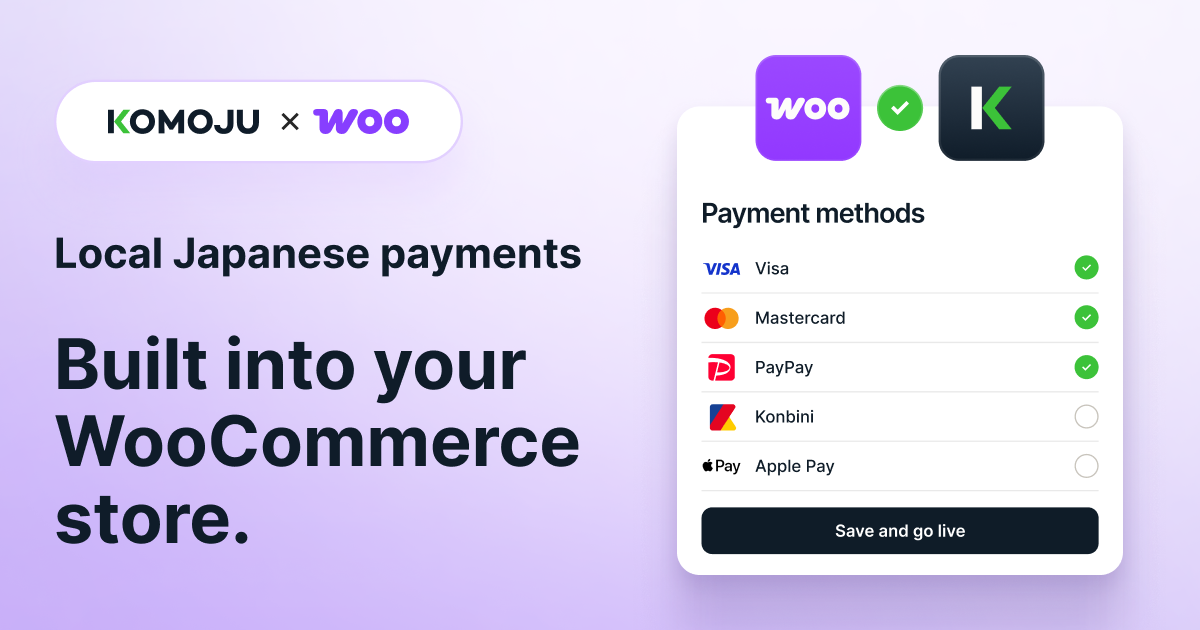
And if you’re on Shopify, WooCommerce, Wix, Magento or Salesforce Commerce Cloud, a plugin connects it without custom code. On a custom build, there’s a full API and mobile SDK. Most merchants are live within a few days.
(Plus, it has built in fraud detection and industry-leading security as standard.)
In short, if you’re selling into Asia – from Japan to Korea and beyond – KOMOJU is the easiest way to localize your checkout.
The bottom line
Asia isn’t one market, and it isn’t even really three similar ones either.
Southeast Asia needs breadth, because there’s no single method that works across its six countries. Japan needs understanding, because its payment methods are tied to how people here think about cash, debt and risk. Korea needs presence, because your checkout is going to live inside the apps people already use all day every day.
Getting all of that working yourself means dozens of separate agreements, in several languages, often over months. KOMOJU replaces that with one integration that already holds the access — for most Japanese methods, without a local entity — and adds the local payment methods for all three regions to your checkout.
Because once you treat Asia as three specific regions with different payment methods and preferences, it becomes much easier to localize your checkout and add the payment methods that customers in those regions want and need in order to feel comfortable buying from you.
To get started adding payment methods from across Asia to your checkout, sign up and get started with KOMOJU for free.
We help businesses accept payments online.