
We help businesses accept payments online.
If you’ve got your head around the nuances and complexities of selling into the Japanese market as a foreign merchant, you probably already know why you need Japanese local payment methods and why Japan is such a unique market for international merchants to sell into.
(Not quite up to speed? Read our in-depth guide on selling into Japan as an international merchant.)
And once you understand why Japan is such an exciting yet complex prospect as a region, the next question is usually: how do you add all of these different payment methods onto your checkout?
Unlike in the West, adding Japanese payment methods is a little more involved than adding the payment methods you need for selling in the USA and Europe.
In fact, Japanese eCommerce stores have more payment methods at their checkouts on average than stores in any other country, with most sites offering nine or more on average, whereas most Western stores get by with four or five.
And it’s not just a range of Credit Cards, either. Japanese customers want to pay in cash at a konbini, use PayPay, pay by bank transfer, add their order to their mobile phone bill, pay with their points-linked wallets…
And each one of those payment methods is there because a different set of shoppers expects it. Without their preferred method of payment, most Japanese customers will find somewhere else to shop.
However, no merchant wants to add all of the Japanese payments one by one, so most stores choose a PSP (payment service provider) who handles that for them. And for most brands selling into Japan, the shortlist comes down to one of two candidates: Stripe or KOMOJU.
So here’s an honest breakdown of the difference between Stripe and KOMOJU and which one might be right for your store.
Does Stripe have Japanese payments options?
Yes. Stripe supports some of the major Japanese methods — credit cards including JCB, konbini payments, bank transfer (Furikomi) and PayPay — and lets you charge customers in yen at your checkout.
Stripe is one of the largest payment platforms in the world, operating in over 135 countries. It launched in Japan in 2016, initially with card payments, and has added local payment methods gradually since, with konbini and bank transfers (Furikomi) launching in 2022, and PayPay launching in 2025.
Does KOMOJU have Japanese payments?
Yes. In fact, the complexity of Japanese payments is the reason that KOMOJU exists. The idea for KOMOJU started as a game publisher, Steam, couldn’t sell games in Japan as well as in other countries because they didn’t accept Japanese payment methods at their checkout.
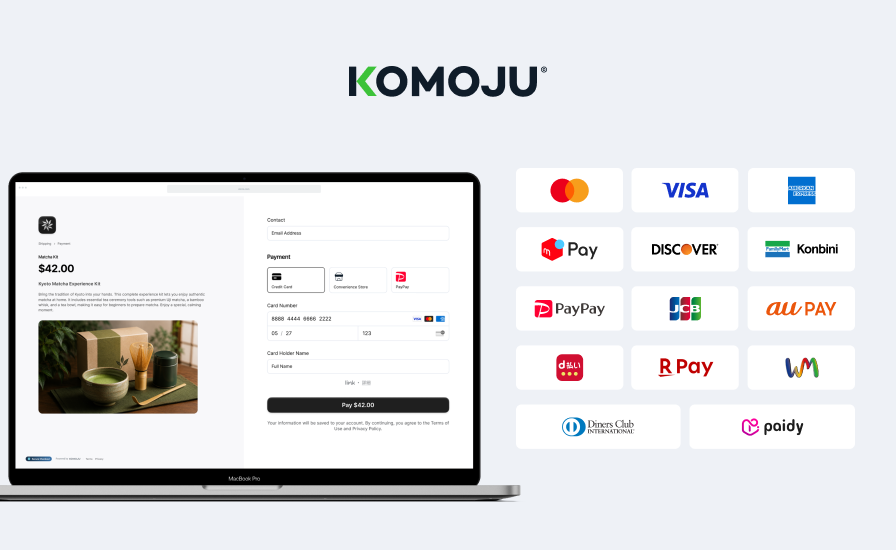
Today, KOMOJU lets merchants offer a large range of Japanese payment methods including Credit Cards (Visa, Mastercard, JCB, Amex, Diners), konbini payments across six chains, PayPay, Merpay, Rakuten Pay, au PAY, d Payment, Paidy, bank transfer, Pay-Easy, prepaid cards like BitCash and WebMoney, and carrier billing through Docomo, SoftBank and au.
You can charge in yen and settle in yen, US dollars or euros.
What's the difference between Stripe and KOMOJU?
Although both Stripe and KOMOJU are payment service providers that you can integrate with your store in similar ways, they’re actually quite different.
Stripe is a global payment platform that has payment methods for selling in Japan. KOMOJU is a Japanese payment platform that specializes in Japan and covers other Asian and South American markets too.
Now, both will give you a working Japanese checkout but with varying levels of localization.
Stripe’s strength is its global coverage. It runs in over 135 countries on one integration, letting you add most major payment methods to your checkout.
KOMOJU’s depth is Japanese. It has more local methods and an expertise built from living and building from within Japan and Japanese payment culture.
So, here’s how the two compare for selling in Japan:
What is a local entity? And do I need one for Stripe and KOMOJU accounts?
A local entity means a company legally registered in Japan and set up with a Japanese corporate registration, a local tax ID, and usually a local address.
Getting a local entity is months of paperwork (in Japanese) and ongoing cost, making it the kind of thing you’d normally do after you’ve got traction in a market, not before you’ve made a sale.
That said, JCB – Japan’s major credit card – is available through Stripe without a local entity for cross-border acquiring, but only to accounts in the UK, US and EEA.
However, to offer other Japanese local payment methods through Stripe – Konbini payments, Furikomi and PayPay – you need a Japan-based Stripe account, which means having a Japanese entity set up or registering locally as a sole proprietor before you can accept any payment.
Which means if you’re already set up and operational in Japan, you can choose between Stripe and KOMOJU. But if you’re entering Japan or trialling the market, KOMOJU is a better fit.
That’s because, for a lot of Japanese methods, KOMOJU doesn’t require you to have a local entity.
In fact, you can launch in Japan with 5 konbini stores payments (Family Mart, Lawson, Mini Stop, Daily Yamazaki and SeicoMart), PayPay, auPay, MerPay, Pay Easy, Furikomi (bank transfer) and Paidy without a local entity.
Even without the full range and a local entity, that gives you a genuinely strong first step into selling in Japan.
You can get set up to accept payments from five konbini chains,PayPay, auPay, MerPay, bank transfer and Paidy, and you’re already covering a lot of the bases you need to be successful in Japan. Adding konbini alone handles around 18% of Japan’s B2C eCommerce, close to ¥3 trillion a year, and bank transfer reaches almost every adult in the country, since virtually every Japanese resident has a bank account. This isn’t a dip-your-toe trial tier. It’s real access to how most of Japan actually pays that you can upgrade and double down on once you’ve set up a local entity.
Which one has more Japanese local payment methods?

KOMOJU has more Japanese payment methods by some distance compared to Stripe, regardless of whether you have a local entity or not.
Stripe’s Japanese line-up is a good way to get started, with cards (Visa, Mastercard, Amex and JCB), konbini payments, bank transfer and PayPay. However, JCB is the only Japan-specific payment option available to international customers without a local entity.
And, if you’ve read our guide to selling in Japan, you’ll know that Japanese customers are very particular about the payment method they use. If your store doesn’t offer their preferred method at checkout – like Rakuten Pay, for example – they’ll close the tab and look elsewhere.
That is why KOMOJU covers all of the same payment methods as Stripe, but also adds Rakuten Pay, au PAY, Merpay, d Payment, Paidy, Pay-Easy, prepaid cards like BitCash and WebMoney, and carrier billing through Docomo, SoftBank and au.
KOMOJU’s goal is to give Japanese and international eCommerce merchants access to payment methods that span the full landscape of the Japanese market, because we know that every different payment method helps merchants unlock different target markets and demographics that otherwise would be closed to them.
Do Stripe and KOMOJU do konbini payments for eCommerce?

Both Stripe and KOMOJU allow you to accept konbini payments, but KOMOJU has two extra konbini chains in its payment network.
Stripe supports konbini at four chains: FamilyMart, Lawson, Ministop and Seicomart. That comes to around 33,000 convenience stores across the country, but you need a local entity to get started.
KOMOJU supports FamilyMart, Lawson, Ministop and Seicomart as well, and Daily Yamazaki and 7-Eleven (7-Eleven requires local entity). That’s the six biggest chains in the country, totalling roughly 56,000 stores between them.
Plus, with KOMOJU, you can launch into 5 of those chains – across around 35,000 stores – without a local entity. That means that even without a local authority giving you access to 7-Eleven stores, KOMOJU gives you access to a greater konbini network than Stripe. And Stripe requires a local entity to get started.
And, local entity aside, KOMOJU’s other clear advantage is allowing merchants to add 7-Eleven for their konbini payments.
7-Eleven is the largest konbini chain in Japan by a distance, with over 21,000 stores, around 5,000 more than its nearest rival, and makes up around one third of all convenience stores in the country.
And accessibility makes a big difference when it comes to konbini payments.
According to government survey data, konbini is one of the most popular ways to pay for online purchases in the country and part of what makes it work is how many stores there are.
7-Eleven alone accounts for more than a third of the konbini across Japan. Which means that a checkout that doesn’t support 7-Eleven is leaving out the single biggest chain, and in the more rural areas where 7-Eleven is often the only konbini around, that can mean no cash-payment option at all for many customers.
In short: both will let your Japanese customers pay in cash at a convenience store. KOMOJU covers more of them, including 7-Eleven, which alone accounts for about a third of the country’s konbini.
Does Stripe or KOMOJU have better pricing for eCommerce businesses?
KOMOJU offers a lot more payment methods than Stripe, so we’ve only compared like-for-likes in the interest of fairness. But, on the whole, KOMOJU has better pricing for eCommerce businesses than Stripe.
Data accurate as of publication date: 30 July 2026.
Neither Stripe nor KOMOJU charges setup or monthly fees, and both pay out on a regular cycle.
It’s also worth noting that Stripe’s pricing for local payment methods adds 1.5% for international transactions, and a further 2% where currency conversion is needed.
Depending on where your business is based and where your customers’ payment methods are issued, that can eat a little more of your margin.
Also, both providers charge more for digital content on PayPay. That’s PayPay’s own pricing model, not a quirk of either gateway.
In short: KOMOJU is a little cheaper on everything the two have in common. The gap is narrow on cards and wide on konbini payments, so how much it’s worth to you depends on how much of your Japanese checkout runs through a convenience store.
Reward points are popular with Japanese customers. Do Stripe and KOMOJU have any point payment options?

Points aren’t a nice-to-have in Japan, they’re a reason people choose one store over another. Rakuten Points alone are used by around 59% of Japanese consumers, and in 2023 Japanese companies issued more than ¥2.65 trillion worth of reward points between them.
KOMOJU lets you add four of Japan’s five biggest to your checkout. Stripe only offers one.
- Rakuten Pay earns Rakuten Points, the most-used program in the country
- au PAY connects to Ponta, which has over 110 million registered accounts
- d Payment earns d Points, accepted at more than 360,000 locations nationwide
- PayPay earns PayPay Points, used by around 38% of consumers.
- Merpay earns Merpoints that can be used at Mercari, Japan’s largest CtoC online flea market and marketplace app.
That makes a huge difference for selling to Japanese shoppers who have strong preferences on payment methods. A Japanese customer on a Docomo phone collecting d Points or a Rakuten Card holder stacking Rakuten Points are deeply loyal and dedicated to collecting points, even going so far as to find a different store or shop elsewhere if they can’t collect their points.
Offering 4 of the 5 major points schemes is a big draw for merchants selling in Japan.
Do KOMOJU and Stripe work with Shopify?
Both KOMOJU and Stripe work with Shopify, but not in the same way.
If you’re on Shopify in Japan, you’re most likely using Shopify Payments, which runs on Stripe under the hood. You don’t need to set Stripe up separately, it’s the engine behind Shopify’s own checkout, handling your card payments automatically.
In fact, in countries where Shopify Payments is available — Japan included — Shopify doesn’t offer standalone Stripe as a separate gateway at all, because the two are already the same thing.
What that setup doesn’t give you is Japanese local methods. Shopify Payments covers JCB (if eligible) but it won’t put konbini payments, PayPay, Rakuten Pay or carrier billing on your checkout.
That’s where KOMOJU comes in. It connects to your Shopify store as an additional payment provider, sitting alongside Shopify Payments and adding the local methods it doesn’t reach.
Cards run through Shopify Payments as usual, but the Japanese methods are processed through KOMOJU if customers choose them.
(KOMOJU also works with WooCommerce, Wix, Magento, and Salesforce Commerce Cloud, and offers a full API and mobile SDK for custom builds.)
Is it faster to start accepting Japanese payments with Stripe or KOMOJU?
This is where the answer gets nuanced, because, really, it depends which methods you need.
If you want to accept Visa, Mastercard, Amex and JCB — Japan’s home-grown network — Stripe is fast and needs no Japanese presence at all if you’re in the US, UK or EEA.
You just open a standard Stripe account in your own country and you can take Japanese card payments, JCB included, more or less straight away. KOMOJU can process the same cards, but its local card acquiring requires Japanese registration, so for cards alone, Stripe is the quicker route for a foreign merchant.
If you want to add local payment methods like konbini, PayPay and bank transfer, they are only available on Stripe to a Japan-based account. That means you’ll need a Japanese entity or a sole-proprietor registration first. Incorporating in Japan can take months and months, and it has to happen before you can switch any of those payment methods on.
KOMOJU needs none of that: no entity to accept konbini, PayPay, auPay, MerPay, bank transfer or Paidy, so you connect and you’re ready to accept via those payment methods within a day or two.
Which is why, for a lot of businesses, the quickest route to a full Japanese checkout without incorporating isn’t one or the other, it’s accepting cards through Stripe and local methods through KOMOJU, each doing the part it can do with no entity at all.
(One caveat on KOMOJU’s konbini: 7-Eleven needs a separate screening that takes one to two months, so you’re live on the five other major chains within a day, but the biggest one takes longer.)
Which is better for selling digital goods or games in Japan?
KOMOJU is by far and away the winner here.
Prepaid cards — like BitCash, NET CASH, WebMoney — are a standard way to buy games and digital content in Japan, particularly for younger players without a credit card. Carrier billing is incredibly popular too.
And they’re only available through KOMOJU. Stripe offers no integration at all.
However, PayPay is a popular payment method for digital content too, and Stripe and KOMOJU offer this.
However, KOMOJU is cheaper: PayPay for digital content is 9% on KOMOJU against 9.48% on Stripe, and cards are 3.25% on KOMOJU whether you’re selling physical or digital.
(Fun fact: KOMOJU’s affiliate company, Degica (now renamed to Komodo), was a game publisher — it brought RPG Maker to Steam — and built Japanese payment infrastructure because it needed it. When Steam wanted to reach Japanese players, konbini went live in 2014, and by 2016 Japan was Steam’s fastest-growing market. We’ve always been about helping digital products adapt to Japan. Read more about how we helped Steam accept Japanese payment methods.)
How do payouts work with KOMOJU and Stripe?
KOMOJU settles in yen, US dollars or euros and is paid out weekly or monthly. Payouts to an overseas bank account carry a flat fee of ¥2,500, $25 or €25 per payout, depending on your settlement currency. Domestic Japanese payouts cost ¥220 to ¥410.
With Stripe, your settlement currency is set by your account’s country. A Japan-based account settles in yen to a Japanese bank. If your charge currency differs from your settlement currency, Stripe converts, and adds 2%.
Are KOMOJU and Stripe secure?
Both are secure to the same baseline standard.
Both KOMOJU and Stripe are certified PCI DSS Level 1 — the highest level in the card industry — and both offer a core fraud toolkit to keep your store secure: 3D Secure authentication, tokenization to keep card details out of your systems, and real-time transaction monitoring.
KOMOJU also holds ISO 27001 and Japan’s Privacy Mark, the local certification for handling personal data, which is worth having if Japanese customer data is a concern for you.
Which one is better for a brand launching in Japan?
If you’re looking to add an extensive range of Japanese local payment options to your store, the answer is easy: KOMOJU.
KOMOJU has more local payment methods, more konbini chains including 7-Eleven, four of Japan’s five biggest points ecosystems against Stripe’s one, and a lower rate on every method the two have in common.
Plus, if you’re not already set up in Japan, then konbini and PayPay are only available on Stripe to Japan-based accounts so you’re limited to just JCB to sell to Japanese customers.
If you’re already established in Japan, then you have a choice.
Stripe gives you one system across every market you sell in, with fraud and billing tooling built for a global operation.
KOMOJU gives you the depth of payment options to sell to the Japanese market.
The good thing? You don't actually have to choose
For most stores that sell in Japan, it isn’t a choice between Stripe or KOMOJU. It’s both.
KOMOJU is built to sit alongside a provider like Stripe, not to replace it.
You can keep Stripe running your cards and your other markets exactly as they are, and route your Japanese local payment methods through KOMOJU — meaning you can accept konbini, PayPay, Rakuten Pay, carrier billing and the rest — on the same checkout.
In fact, running more than one provider is standard on Shopify and most major eCommerce platforms.
Sure, two providers is marginally more to manage than one provider, but it’s a great deal less than rebuilding a global payment stack, and less costly than leaving Japanese shoppers at a checkout that hasn’t been built for them.
The bottom line
Stripe is an amazing global platform that is built for breadth, not depth. For Japan, it covers a few of the main Japanese methods, but it wasn’t built for Japan specifically.
And that outside-in approach to Japan shows in what it can’t offer a foreign merchant without a local entity, and in how much of the local payment methods it simply doesn’t reach.
KOMOJU was built for exactly this. It gives international merchants more methods, cheaper rates, and access to a strong set of Japanese payment options without needing to set up a company in Japan first.
But you don’t have to choose. You can keep Stripe for everywhere else and let KOMOJU handle your Japanese payments, giving you a checkout that’s optimized wherever you’re selling in the world.
To get started accepting Japanese payment methods to your checkout, sign up and get started with KOMOJU for free.
We help businesses accept payments online.