
We help businesses accept payments online.
If you’re running a Shopify store and selling into Japan — or maybe you’re starting to think about it — you’ve probably already worked out the logistics, shipping, and product side of things.
But logistics isn’t usually where merchants run into trouble in Japan. It’s actually Japan’s unique payment culture that catches a lot of first-time merchants out.
In most Western markets, if a shopper can’t find their preferred payment method, it’s frustrating and poor customer experience, but roughly 80% of the time they’ll find an alternative way to pay and complete the purchase anyway.
But Japanese shoppers have a fundamentally different relationship with payment methods than Western customers do.
So while most articles will tell you that Shopify Payments is available in Japan and how to set it up, they miss the nuance of exploring how to make sure you’re set up to offer the payment methods that Japanese customers expect to see at the checkout in order to feel comfortable buying from you.
At KOMOJU, we’re experts in helping merchants sell in Japan, so we’ve put together a guide that explains:
- Exactly what’s missing from your Shopify checkout
- Why not offering the right payment methods is a conversion-killer in Japan, and
- How you can add many of the preferred Japanese payments to your checkout without setting up a local entity.
Does Shopify operate in Japan?
Yes, Shopify operates in Japan and Shopify Payments – the built-in payment gateway that lets you natively accept payments – has a few Japanese payment methods out of the box.
In fact, while Amazon Japan and Rakuten Ichiba dominate Japan’s eCommerce headlines, it’s actually Shopify that powers the most independent eCommerce stores across Japan.
According to ECDB’s Japan market data, Shopify is Japan’s leading eCommerce shop software, with Shopify stores in Japan growing 16% year-on-year in Q4 2025.
(This lines up with our internal data showing more and more international merchants choosing to use our Shopify plugin every year.)
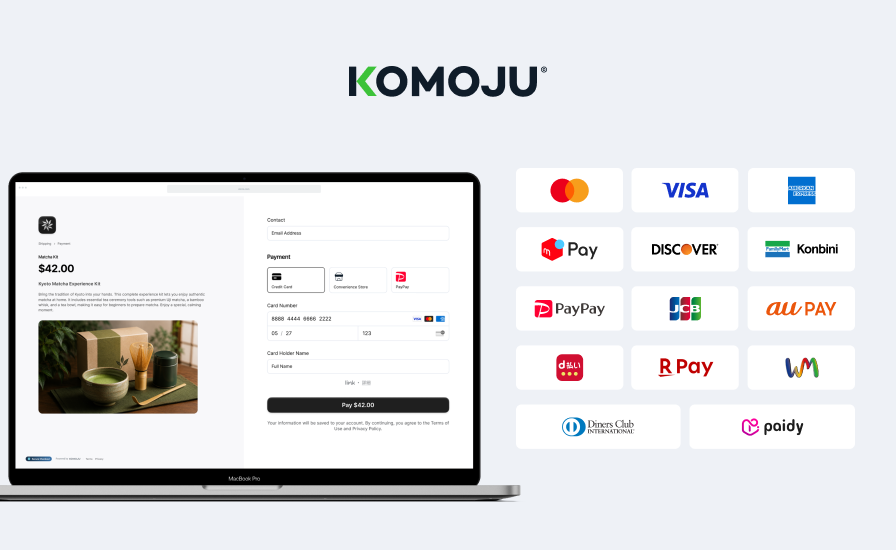
You can accept Japanese payment methods with Shopify too, with Shopify Payments letting you add Visa, Mastercard, American Express, JCB, Apple Pay, Google Pay, and PayPal to your checkout.
And for an international store entering the Japanese market, that’s a good starting point.
Being able to accept JCB out-of-the-box, a Japan-specific credit card for taking Japanese card payments, is the first step towards Japanese adaptation that customers expect.
But as we know, for Japanese audiences, that’s not enough. And when they can’t see localised Japanese payment methods, research consistently shows they just leave.
Why do Japanese shoppers use so many payment methods? And why isn’t accepting Japanese yen enough to grow in Japan?
Shopify Payments covers Visa, Mastercard, American Express, JCB, Apple Pay, Google Pay, and PayPal. In most markets, that would be enough to convert most customers.
In Japan, it isn’t.
The important thing to remember is that Japanese shoppers don’t just use alternative payment methods because they’re convenient.
Here in Japan, there’s a cultural relationship with cash, debt, and online security that shapes every detail of how Japanese people want to shop.
In most Western markets, eCommerce payment is overwhelmingly digital: credit and debit cards, digital wallets, buy now pay later… And even though there are cash at the point of delivery options in a few European countries and for a few services in the US, it’s the exception rather than the default.
In Japan, the payment landscape is a lot more varied.
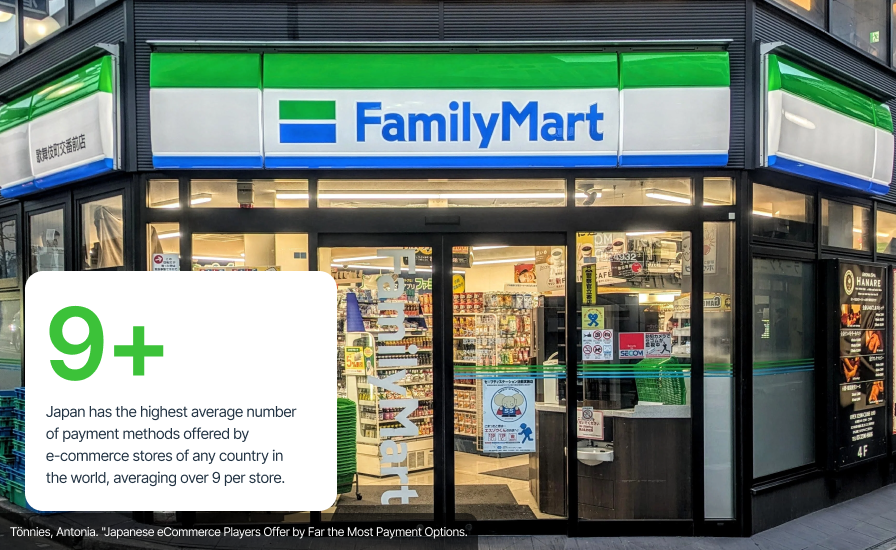
In fact, Japan has the highest average number of payment methods offered by ecommerce stores of any country in the world, averaging 9+ methods, while most Western countries offer 4 or 5.
Which is why most merchants who launch on Shopify and do the obvious things (like prices in yen, JCB as a payment option) still struggle to bring their cart abandonment rates down.
Because growing in Japan comes down to something that doesn’t show up in a checklist: adapting to how Japanese consumers relate to money.
Take credit cards for example. Credit card ownership in Japan is high — around 70%, slightly above the US — but Japanese cardholders use them carefully and pay them off in full.
Revolving debt, which is considered normal in the US and UK, carries a weight and shame here that doesn’t really translate. A Japanese shopper with a perfectly good credit card might still choose not to use it online because it comes with an extra cultural weight.
But that is the reason PayPay is so popular. Customers can load money in and spend it online like a credit card, but without the added baggage and have the added benefits of strong security and earning points they can use on future purchases.
But debt and shame aren’t the only thing that makes Japan a complex market to enter. Japan also has a deeply cash-first culture which doesn’t immediately feel like it fits with eCommerce.
Japan’s cash-to-GDP ratio sits at around 20%, which is high, especially compared to 8% in the US and less than 1% in Sweden.
After decades of near-zero interest rates, Japanese consumers don’t have the same approach to using a bank account that there is around the world because there’s little incentive to move it out of cash.
On top of that, Japan is a country that lives with the regular possibility of earthquakes and typhoons, which gives cash has a practical edge: it still works when the power and networks are down.
Add onto the fact that Japanese consumers are uneasy about conducting financial transactions online, and you end up with a cultural attitude towards money that is enough to keep many people from using a credit card online, even when they own one and would rather use it.
What cash represents, then, isn’t just “money” for Japanese customers.
It’s the absence of debt, the absence of fraud risk, and something that always works.
In other words, Japan’s relationship with money and cultural attitudes towards how they spend are idiosyncratic and specific to Japan.
And when your checkout doesn’t offer these payment methods, it doesn’t just create friction. It signals that your store wasn’t built for Japanese shoppers.
How does offering Japanese payment methods reduce abandoned carts for Shopify stores?
Offering Japanese payment methods reduces abandoned carts for one simple reason: not being able to pay how they like is a major reason that Japanese shoppers abandon their cart in the first place.
In most Western markets, reducing your abandonment rate is often about making UX and CX checkout optimisations like tidying up the checkout flow, adding a guest option, layering in trust badges and adding more abandoned cart emails.
In Japan, the biggest difference you can make is letting people pay how they want.
As we mentioned, when a shopper in the US or Europe doesn’t see their preferred payment method at checkout, they tend to just pick another option and complete the order.
Japanese customers won’t do the same.
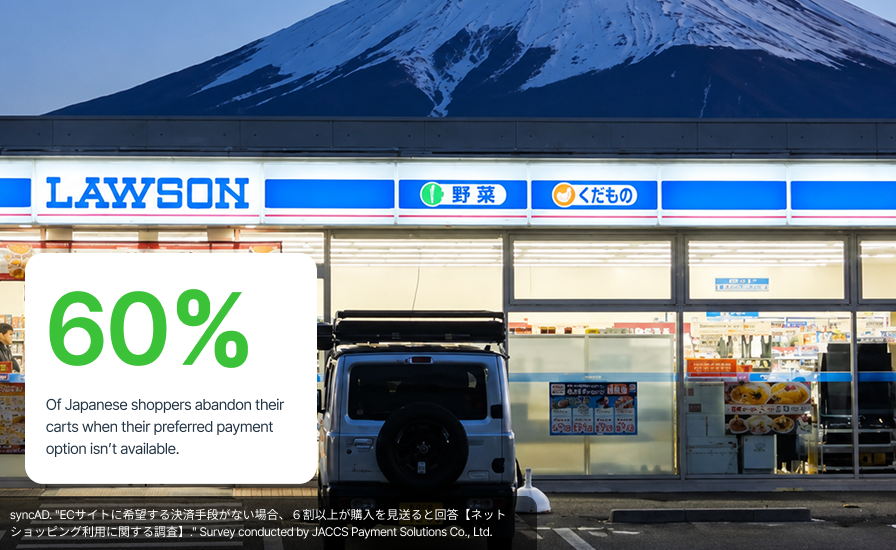
They’ll abandon the purchase completely or check if your competitor offers their preferred payment method. In fact, over 60% of Japanese shoppers abandon their carts when their preferred payment option isn’t available.
On top of that, according to a 2025 survey, the amount of opportunity loss caused by abandoned carts (i.e, the total value of items left in the cart but not purchased) is approximately 2.6 times the actual sales amount.
Yet, while Japan has one of the highest abandonment rates, it’s also the world’s fourth-largest eCommerce market, with online sales projected to reach $701.8 billion by 2034 and grow at 10% every year.
On top of that, Japanese consumers spend up to $455 on a single online purchase, $77 more than the global average.
By offering Japanese customers the payment methods they expect to see at checkout, you can remove obstacles from the checkout process, reduce abandoned carts and build brand loyalty all at the same time.
What are the main payment methods you need to fully optimize your checkout for the Japanese market?
Making sure your checkout is Japan-ready means having payment methods that cover the full range of how people actually pay here: cards, cash-based payments at convenience stores, digital wallets, installment options that don’t require a credit card, and direct bank transfers.
Here are the ones we would recommend to any store that wants to grow in Japan.
Konbini (convenience store payments)
Konbini payments are probably the clearest sign of how prevalent cash culture is in Japan and a main point of difference in payment practices from western markets. When a customer goes through your checkout, rather than pay directly through your store they choose konbini, receive a payment code by email and then pay in cash at any of Japan’s 55,000+ convenience stores.
Every year, nearly 20% of Japan’s online payments are made using konbini. Yet for many Western Shopify merchants, it’s an unfamiliar method that feels risky because of the seven-day payment window.
In practice, konbini payments convert at over 80%, much higher than the average credit card conversion rate. Japanese shoppers who commit to a purchase at checkout follow through, because visiting a konbini is part of daily routine for most urban consumers. Plus, because payment is confirmed before goods are shipped, chargebacks and payment disputes are eliminated entirely.
PayPay
PayPay is the closest thing Japan has to a universal payment app and it is the leading mobile wallet. In 2024 alone, PayPay processed 7.46 billion transactions, around 20% of all cashless transactions in Japan.
One of the main reasons that PayPay is so popular is Japan’s relationship with points. When customers use PayPay for a purchase, they get points that can be used for future purchases. PayPay runs frequent cashback and points campaigns that actively drive people to use it and many will choose a store that accepts PayPay over one that doesn’t.
By allowing Japanese customers to pay with PayPay, you open your store to roughly half of Japan’s population, as it has 70 million registered users. Not only that but PayPay allows you to reach two consumer groups that credit cards leave out, younger shoppers who are unable to apply for a credit card and older shoppers who are more wary of digital payments and prefer the reassurance of PayPay.
Rakuten Pay
Just like PayPay, the popularity of Rakuten Pay in Japan is less about the payment method itself and more about points. While most western shoppers see loyalty schemes and points as a nice-to-have bonus, Japanese shoppers actively decide where to buy based on earning points.
Nearly 60% of Japanese consumers use Rakuten Points for shopping, travel, banking and mobile. By accepting Rakuten Pay, you not only allow Japanese customers to use their preferred payment method, you encourage them to keep coming back to earn points through your store.
Paidy (instalments without a credit card)
Paidy is Japan’s take on buy-now-pay-later, but it works against a very different backdrop from Klarna or Afterpay. In the West, credit cards are built around the acceptance of revolving credit: you can carry a balance, pay the minimum or an instalment, and spread the cost, with interest as the trade-off.
Japan works the other way around. The standard way to use a credit card there is to pay the full balance the following month, in one lump sum, with no interest. Splitting a purchase into instalments means switching to a revolving or instalment plan that typically charges somewhere around 15 to 18% interest, and that kind of borrowing carries real cultural weight, often read as getting into debt.
Instead, Paidy lets customers split a purchase into instalments with no interest on its shorter plans, no credit card, and no credit application. In a culture where the default is to pay in full and where revolving credit is viewed warily, Paidy offers a way to spread payments that feels lighter and free of that baggage, which is a big part of why it has grown to more than 6 million users.
Bank transfer (Pay-easy)
Japanese shoppers are wary about typing card details into a site they don’t know yet, and for good reason. In 2023, 93% of Japan’s credit card fraud losses came from stolen card numbers used at eCommerce sites.
But a store that offers Pay-easy removes that concern entirely. Rather than entering card details into your checkout, Pay-easy lets customers move money directly from their bank account to yours, all done through Japan’s ATM and online banking infrastructure.
For shoppers who won’t hand over card details to an overseas store they haven’t used before, it’s often the only payment method that makes a larger purchase feel safe enough to complete.
That’s why it’s most common for electronics, luxury goods, and high-value first orders from foreign merchants.
Prepaid wallets
Popular with younger Japanese shoppers that pay online, especially those interested in gaming and digital-content, pre-paid wallets give them a way to spend online without linking any account or exposing any card details. They just add money to the card and spend it online.
In fact, Japan’s prepaid card market was valued at over $108 billion in 2024, with gaming and digital content among the strongest categories. And with 82.59 million active gamers in Japan — making up 67% of the total population — the gaming audience alone represents a significant slice of ecommerce spend.
How do you add Japanese payment methods to your Shopify checkout?
Japanese payments might seem complex, but adding them to your Shopify checkout is simple. Just connect a third-party payment gateway alongside Shopify Payments, and that will add Japanese payment methods to your checkout without rebuilding anything.
In your Shopify admin go to: Settings → Payments → Alternative Payment Methods. No custom code required.
KOMOJU’s Shopify integration connects your store to the full range of local methods that different Japanese shoppers expect, from konbini payments and PayPay to Rakuten Pay, MerPay, au PAY, Paidy and bank transfer, all through a single KOMOJU account.
And for most of these methods, you don’t need a Japanese legal entity, and you don’t need to negotiate directly with any of the payment networks.
What should you expect when setting up Japanese eCommerce payments?
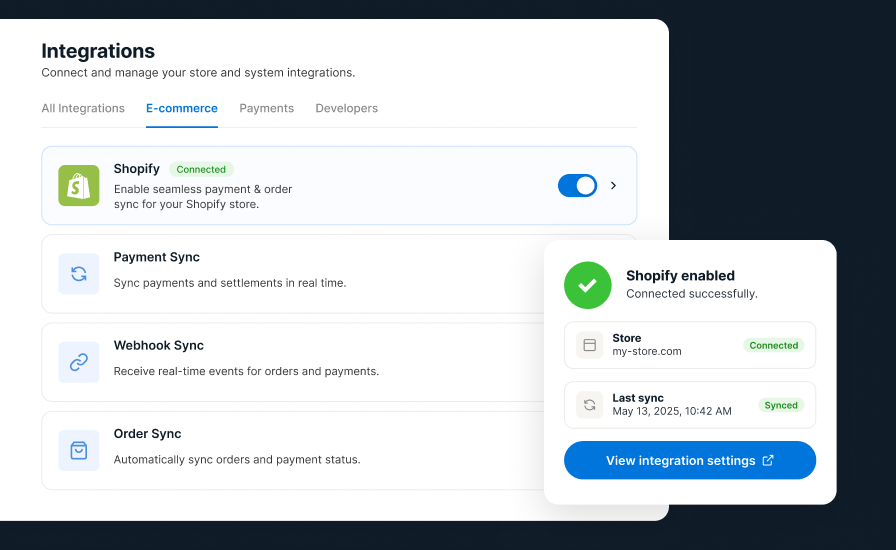
The Japanese payment market can look intimidating from the outside, but KOMOJU keeps the setup simple. You add the Japanese payment methods you want (plus payments from across Asia and South America) in just a few clicks.
Here’s how it works:
Step 1: Create your KOMOJU account. The application is online and takes a few minutes. You’ll need standard business-verification documents, the same kind you’d give any payment provider.
Step 2: Quick review. KOMOJU runs a quick check to confirm your product category and order details. (It’s all in English too, no Japanese required.)
Step 3: Connect to Shopify. In your Shopify admin: Settings → Payments → Alternative Payment Methods → search for KOMOJU. Once connected, Japanese payment methods appear at your checkout automatically. No custom code needed.
Step 4: Choose your Japanese payment methods. From your KOMOJU dashboard, switch on the methods you want, such as konbini payments, PayPay, Rakuten Pay, Paidy, bank transfer, and more. KOMOJU will then handle getting them approved and added to your checkout.
Step 5: Test before going live. It’s worth running a test konbini payment in particular. The confirmation email is what your Japanese customers rely on to complete their payment in-store, so you’ll want to see exactly what they’ll see before you launch.
Full technical documentation at the KOMOJU getting started guide →
The bottom line: Shopify Payments gets you into the Japanese market, but growing in Japan takes a lot more.
When you’re building on Shopify and processing through Stripe or Shopify Payments, it’s natural to assume you’re covered for all global payment options.
However, Japan’s payment culture didn’t develop alongside Western financial infrastructure. It developed here, on its own terms, shaped by a relationship with cash, debt, and trust that has no real Western parallel.
The methods that reflect that culture — konbini payments, Rakuten Pay, au PAY, Paidy — aren’t all available on Stripe or western payment providers yet.
They exist because of lots of specific nuances about how Japanese people relate to and spend money, and that means the infrastructure around them can take years to build inside the Japanese market.
That’s what we built KOMOJU for. Not a payment gateway that happens to support Japanese methods, but a payment provider that was built here with the merchant agreements, the payment network relationships, and the local compliance infrastructure already in place.
You don’t have to negotiate with each payment provider or figure out which payment methods your Japanese customers want. You just connect your Shopify store, turn on the payment methods, and let your customers pay however they’re most comfortable.
And, best of all, you can stack it on top of your Shopify Payments and Stripe integrations so you can add Japanese payment methods without rebuilding your whole payment stack.
Shopify Payments Japan FAQs
The customer picks konbini at checkout, gets a payment code by email, and pays in cash at a convenience store. You receive confirmation, usually within an hour, and ship once it lands, so there’s nothing to charge back. KOMOJU supports six chains, covering the majority of the network. The standard payment cap is ¥300,000, with a ¥190 fee charged to the customer per transaction, which is standard across the industry and expected by Japanese shoppers. Customers get seven days to pay, and unpaid orders simply expire at no cost to you.
Credit and debit cards, used by over three-quarters of Japanese online shoppers are still the dominant form of cashless spending. That said, konbini payments, PayPay and other wallets each hold a meaningful share, which is why a card-only checkout still leaves money on the table in Japan.
Around 40 countries (up from 23 in 2024), including Japan, the US, UK, Canada, Australia, Singapore, Mexico and most of Europe, with the full, current list on Shopify’s supported-countries page. Eligibility is based on where your business is registered, not where your customers are, so a business in a supported country can sell into Japan but still needs a gateway like KOMOJU for the local methods Shopify Payments doesn’t cover.