
We help businesses accept payments online.
For cross-border merchants entering the Japanese eCommerce market, offering the right mobile payment methods is essential. While Shopify natively supports globally recognized options like Apple Pay and Google Pay, Japanese consumers also rely heavily on local payment methods such as PayPay, Rakuten Pay, Merpay, and d-Barai. This guide explains how mobile payments work in Japan, which methods matter most, and how to set them up on your Shopify store.
TL;DR: Shopify natively supports Apple Pay and Google Pay in Japan, but local payment methods like PayPay, Rakuten Pay, Merpay, and d-Barai require additional integration through a payment provider such as KOMOJU.
What Are Mobile Payments?
Mobile payments are transactions that are completed digitally, either through a smartphone or a connected device, such as a digital wallet, QR code, or your saved credentials. With the growth of mobile shopping, mobile payment methods are critical to providing fast, convenient checkout experiences and improving eCommerce conversion rates.
Credit cards, Apple Pay, and Google Pay are the most widely recognized and accepted mobile payments and are considered standard worldwide. However, for cross-border merchants entering the Japanese eCommerce market, these payment methods on their own are simply not enough.
It is important to understand Japan’s mobile payment method ecosystem not only through the various payment solutions it offers, but also that many of them are tied to trusted platforms with built-in loyalty systems. This familiarity is a critical factor in increasing conversions in Japan, as shoppers are more likely to complete checkout with a recognized and trusted payment method.
These expectations present an important challenge for Shopify merchants entering and expanding in Japan, as many locally used mobile payment methods require additional integration.
The Rise of Mobile Shopping and Payments
Developments in eCommerce and rapid advancements in technology have made shopping more convenient, seamless, and borderless. Smartphone adoption and increased mobility usage rates across all age groups also mean that mobile is now the primary checkout device for most online purchases.
For eCommerce merchants, this reflects how digital payments have become integrated into daily life globally, and understanding the direct impact that the payment process has on conversion performance. According to research, improving the user experience at checkout can also increase the likelihood of customers completing their purchases. This is especially important for mobile, which tends to have higher cart-abandonment rates than desktop.
For merchants expanding into Japan, in addition to offering mobile-first checkout, it is also important to understand how Japan’s mobile payment ecosystem differs from Western markets. Unlike North America and Europe, where credit cards dominate, Japan has a wider range of payment methods that include various types of QR code payments, digital wallets, and payments linked to carriers. Daily shopping is supported by payment apps like PayPay, Rakuten Pay, Merpay, and d-Barai.
Success for Shopify merchants entering Japan’s eCommerce requires more than just a well-designed storefront and Japanese translation. Merchants also need to offer payment methods that are already recognized and trusted by Japanese consumers.
Mobile Payments in Japan
Japan offers a variety of payment methods; there has been a gradual shift toward mobile payments over the past decade, driven by government-led cashless initiatives and changing consumer habits. As of 2026, the country has not only achieved this rate but exceeded it, with 60% of payments being cashless.
The Growth of Smartphone Ownership & Usage in Japan
Mobile usage continues to rise across multiple demographics in Japan; while younger shoppers are accustomed to mobile-first shopping experiences, there is also an increase in adoption among older age groups. This has made mobile payments more widely accepted and turned smartphones into everyday “shops” for consumers.
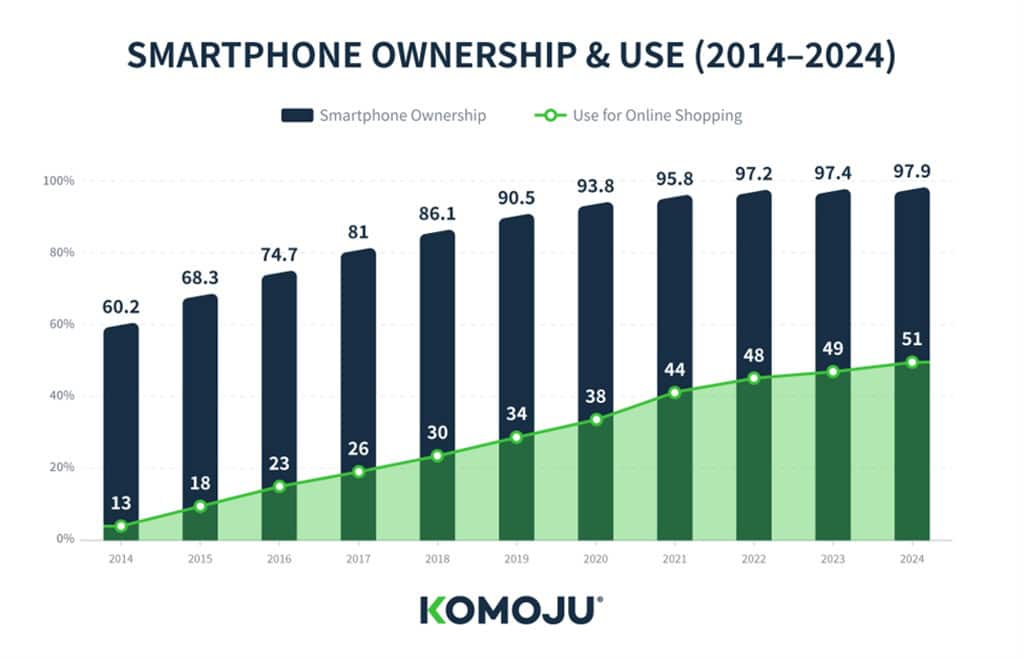
Source: Video Research, 2025
As of 2024, almost 98% of the Japanese population owns smartphones, which is up from 60% in 2014, as indicated in the graph above. Simultaneously, there has been a steady growth of people shopping on smartphones to 51%, a steady growth from 2014 when mobile shopping was only 13%.
For Shopify merchants entering Japan, this reflects a major shift toward mobile-first eCommerce behavior, emphasizing the importance of mobile optimization and building trust through localization.
Mobile Payment Adoption Trends in Japan (2019–2024)
According to research by Dentsu, 8 out of 10 people in Japan use cashless payment methods, with digital payment and mobile wallets being the most commonly used across multiple generations in Japan.
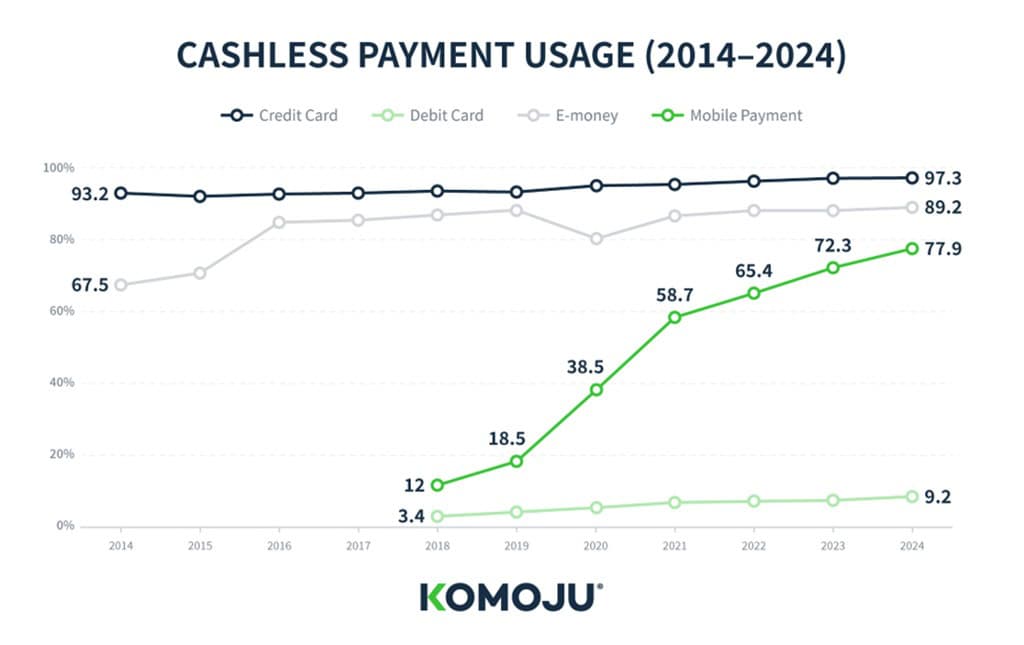
According to Video Research (2025), This graph shows the growth of mobile usage of cashless payments in Japan from 2014 to 2024, with credit cards, electronic money (IC cards like Suica, PASMO, nanaco), and mobile payments like PayPay, Rakuten Pay, d-Barai, etc being the top 3 payment methods.
For Shopify merchants entering Japan, this means that offering localized mobile payment methods is a core strategy for growing in the Japanese market. It is essential in meeting Japanese consumers’ expectations and building trust to increase conversions.
Types of Mobile Payments for eCommerce
There are different types of mobile payments, each with unique features. They are, however, all designed to make online purchases faster, more convenient, and create a smoother checkout experience for mobile shoppers.
Credit and Debit Card
Credit cards and debit cards are recognized globally, and one of the most widely used payment methods in Japan, with mobile shoppers accessing them through mobile wallets.
Key features include:
- Accepted universally and works across all eCommerce platforms
- Support both one-time and recurring payments
- Are often integrated directly into eCommerce platforms’ checkout systems
- Compatible with digital wallets
Digital Wallet
Digital wallets allow faster checkout by providing customers with a secure method to store their payment information on their smartphones or connected devices. In Japan, they have become the default checkout method for mobile shoppers.
Key features include:
- Faster checkout as payment information is already saved, reducing manual card entry
- Quick authentication via Face ID, fingerprint, or PIN
- Works across channels (in-app, web, and in-store)
- Often connected to loyalty programs to increase repeated use
Buy Now, Pay Later (BNPL)
Buy Now, Pay Later (BNPL) services allow customers to split purchases into smaller installment payments over time. In Japan, this is similar to on 後払い (atobarai) or deferred payments.
Key features include:
- Zero-Interest with the ability to split purchases into 3 or 4 equal payments
- Lower upfront costs, which allow customers to make higher-value purchases as payment is spread out
- Popular with younger Gen Z and millennial shoppers
- No lengthy applications required after initial approval
QR Code Payment
QR code payments allow customers to make purchases by scanning a QR code through a mobile payment app. In Japan, QR codes also function as digital wallets, with services like PayPay also having QR code features.
Key features include:
- Payment is processed by scanning a code (provided by either the merchant or the customer)
- No hardware is required to set up and create
- Works across all channels (in-store, online, and in-app)
- Widely used in Asia, especially Japan, China, and Southeast Asia, far more than in North America or Europe
- In Japan specifically, QR is the defining mobile payment format. PayPay, Rakuten Pay, Merpay, and d-Barai all use QR as their primary interaction method
Mobile Payments in Japan
Japan’s mobile payment landscape is tied to local customers and preferences, and not all payments are natively supported by Shopify. Some may require a third-party provider like KOMOJU to integrate them into a Shopify storefront.
The table below highlights some of the most commonly used mobile payment methods in Japan and how they fit into Shopify.
○ = Yes / Accepted / Available ✕ = No / Not Available / Not Supported
▲ = High △ = Moderate ◎ = Very High ↗ = Growing ▼ = Low
Payment Method | Native Shopify Support | Requires Provider | Popularity in Japan |
Apple Pay | ○ | ✕ | ▲ |
Google Pay | ○ | ✕ | △ |
PayPay | ✕ | ○ | ◎ |
Rakuten Pay | ✕ | ○ | ▲ |
Merpay | ✕ | ○ | ↗ |
d-Barai | ✕ | ○ | ▲ |
PayPay
PayPay is one of Japan’s largest and most widely used QR code payment services for both online and in-store purchases. It is popular across all age groups, especially for its reward programs and promotions. Providing it as a payment method is important for Shopify merchants who want to reach Japanese consumers.
Rakuten Pay
Rakuten Pay is widely used by Japanese shoppers and is part of a broader eCommerce ecosystem that includes banking and a rewards and points system. For Shopify merchants, offering Rakuten Pay as a payment method allows them to tap into a strong loyalty-driven user base that prioritizes convenience and loyalty points.
Merpay
Merpay is a mobile payment service that is connected to Mercari, one of Japan’s largest C2C marketplace platforms. It supports QR code and app-based payments and is beneficial for Shopify merchants who want to reach younger tech-savvy consumers who are already using the Mercari App.
Apple Pay
Apple Pay is widely recognized due to the large number of Apple users and its direct implementation into iPhones and Apple devices. Unlike PayPay, Rakuten Pay, and Merpay, Apple Pay is supported natively by Shopify Payments and does not require a third-party provider for integration.
How to Implement Mobile Payments on Shopify
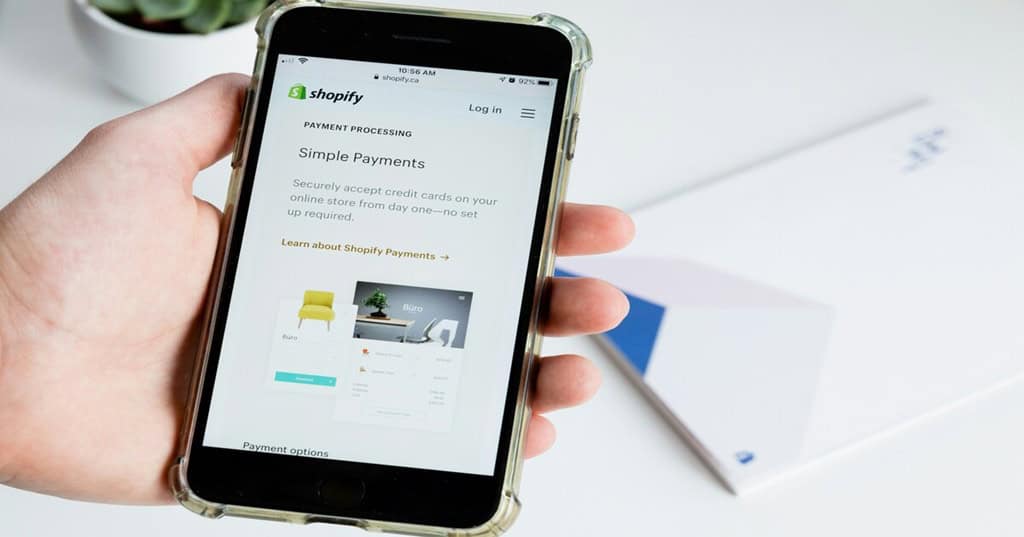
Setting up mobile payments on Shopify is straightforward and can be done in one of two ways:
- Using Shopify’s Built-in Mobile Payment Options for payment methods supported directly through Shopify Payments
- Using a Third-Party Payment Provider for Local Japanese Payment Methods
Shopify’s Built-in Mobile Payment Options
Shopify Payments natively supports:
- Major credit cards such as Visa, Mastercard, American Express, and JCB
- Apple Pay
- Google Pay
These payment methods can be activated directly through Shopify Payments without additional integration from a third-party provider.
Apple Pay
Apple Pay is available as an accelerated checkout option through Shopify Payments. It allows customers to complete purchases on compatible Apple devices and browsers through Face ID, Touch ID, or device passcodes.
Google Pay
Google Pay is also available as an accelerated checkout option through Shopify Payments on compatible Android devices and supported browsers like Chrome. Like Apple Pay, Google Pay is only available when Shopify Payments is activated.
Using a Payment Provider for Local Japanese Payment Methods
While Shopify Payments supports Apple Pay, Google Pay, and major credit cards natively, it does not directly support Japan’s most widely used payment methods like PayPay, Rakuten Pay, Merpay, and d-Barai.
To offer these payment methods, merchants need to work with a third-party provider that understands and supports Japanese payment methods.
How KOMOJU Localizes Shopify Payments in Japan
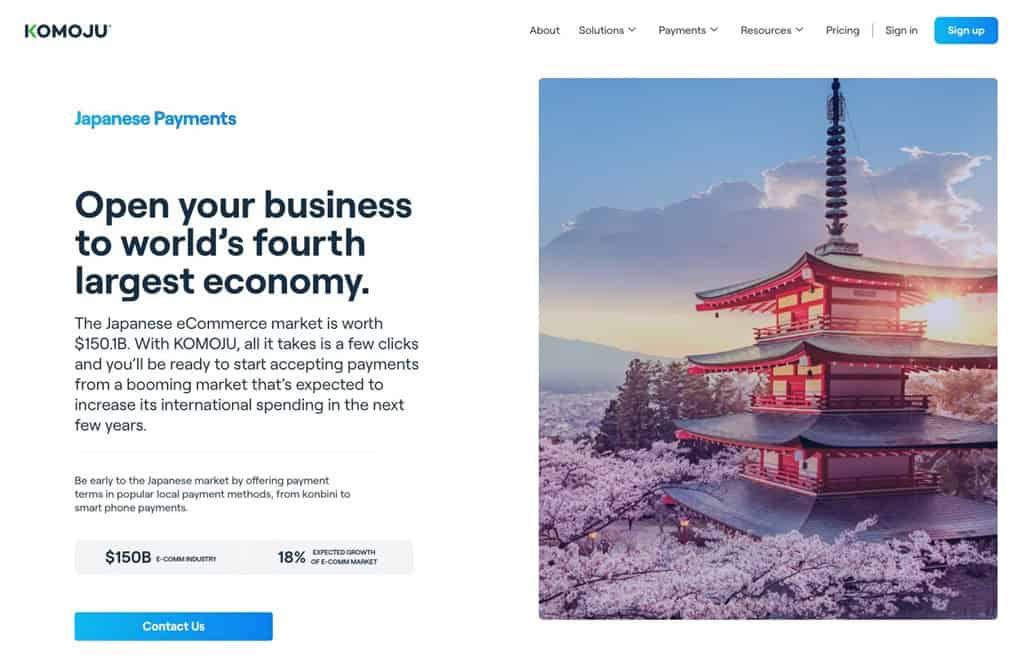
KOMOJU bridges the gap between Shopify’s native payment support and the local payment methods used by Japanese consumers.
It is designed to handle both sides of a Shopify storefront in Japan through a single integration. Merchants can support major Japan-specific payment methods while also maintaining access to globally recognized payment options.
This allows merchants to create a more localized checkout experience for Japanese consumers while simplifying payment management for cross-border ecommerce businesses.
How to Integrate KOMOJU in 3 Steps
Integrating KOMOJU with Shopify is designed to be straightforward for merchants entering the Japanese market.
1 Sign up and create a KOMOJU merchant account through the official getting started page.
2. Install the KOMOJU app from the Shopify App Store and connect it to your Shopify store.
3. Activate the payment methods you want to offer, including PayPay, Rakuten Pay, Merpay, and d-Barai.
Why KOMOJU for Japan
For eCommerce merchants entering Japan, KOMOJU is designed specifically to help merchants simplify payment localization for Japan while supporting both local and global ecommerce transactions. You can view the full list of supported payment methods for Japan on the KOMOJU website.
Key benefits include:
Single integration for multiple Japanese payment methods
Merchants do not need separate accounts for different payment methods; through a single integration, they can offer PayPay, Rakuten Pay, Merpay, d-Barai, konbini, BNPL, and other local payment methods.
No monthly fees
Payments are per transaction with no fixed costs, which is especially important when testing out the market in Japan.
AI fraud detection
Merchants automatically have protection against fraudulent transactions and chargebacks.
Oversell protection for Shopify merchants
Merchants can avoid overselling through the built-in inventory management system, ensuring that they never run out of stock.
English-language merchant support
Language can be a barrier, and KOMOJU provides support in English.
These features allow cross-border ecommerce merchants to localize their Shopify checkout for Japan without extra costs, technical complexities, or additional staff. This helps to reduce the operational complexity of managing multiple payment providers while improving compatibility with local customer payment preferences.
Summary | Meet Japanese Customers with the Right Mobile Payment Options
Mobile payments have become an essential part of eCommerce in Japan, and payment localization plays an important role in creating a smooth checkout experience for Japanese consumers and increasing conversion rates.
Key takeaways:
- Mobile-first shopping behavior continues to grow in Japan
- Google Pay and Apple Pay are widely used globally
- Japanese consumers rely heavily on trusted local payment ecosystems
- PayPay, Rakuten Pay, Merpay, and d-Barai are important mobile payment methods for Japanese shoppers
- Shopify Payments supports Apple Pay and Google Pay natively
- Local Japanese wallets require additional payment integration
- KOMOJU helps Shopify merchants support both Japanese and global payment methods through a single integration
Start accepting PayPay, Rakuten Pay, Merpay, and d-Barai on your Shopify store with KOMOJU.
FAQ
Can you make payments on your phone with Shopify?
Yes. Mobile payments are supported on Shopify through Shopify Payments and other compatible payment providers, allowing merchants to accept payments through mobile wallets, accelerated checkout options, and smartphone-based payment methods.
What are the three types of mobile payments?
The three most common types of mobile payments are:
- Digital wallets
- Credit and debit card mobile payments
- QR code payments
Many payment platforms combine multiple payment technologies into one mobile payment ecosystem. For example, PayPay functions as both a digital wallet and a QR code payment service.
Does Shopify support PayPay and Rakuten Pay natively?
No. Shopify Payments does not natively support PayPay or Rakuten Pay in Japan. Merchants must integrate a third-party payment provider such as KOMOJU to offer these payment methods.
What payment methods are most popular in Japan?
Some of the most popular mobile payment methods in Japan include PayPay, Rakuten Pay, Merpay, and d-Barai. Apple Pay and Google Pay are also widely used, particularly for contactless and mobile-first purchases.
We help businesses accept payments online.