
We help businesses accept payments online.
Japan is the world’s fourth-largest eCommerce market, behind only China, the United States, and the United Kingdom, with online sales totaling ¥26.1 trillion in 2024, according to Japan’s Ministry of Economy, Trade and Industry (METI), based on the latest available data. This makes Japan an excellent opportunity for global businesses to reach new customers or expand their operations here.
This article demonstrates 10 eCommerce trends shaping Japan in 2026, including market growth, consumer behavior, technology adoption, and payment preferences. Understanding these will help businesses entering or expanding in Japan make better decisions and build a strong foundation for long-term growth.
Learn about Japanese eCommerce
Japan’s B2C eCommerce market has more than doubled over the past decade, growing from ¥12.8 trillion in 2014 to ¥26.1 trillion in 2024. Growth dipped in 2020, but the market returned to a steady climb from 2021 onward, reaching a new high in 2024.
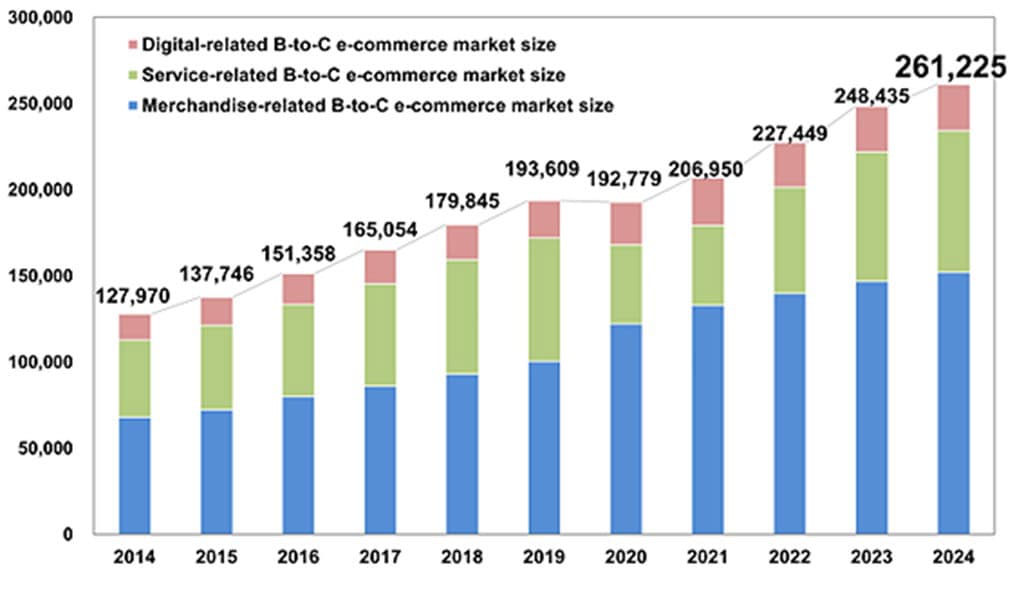
Results of FY2024 E-Commerce Market Survey by METI
Much of this growth has been driven by merchandise, which accounts for the largest share of online sales in Japan, alongside an upsurge in digital services and online platforms. Increasing smartphone usage, faster delivery infrastructure, and wider adoption of cashless payments have made online shopping more accessible and convenient for Japanese consumers.
While Japan is already highly developed, eCommerce continues to create opportunities for new and existing merchants to capture market share—particularly those that adapt to local consumer preferences and payment methods.
Main eCommerce Marketplace in Japan
Marketplace | Monthly Visitors (Japan) | Features | Metrics |
Amazon Japan
| ~670–700 million visits/month (Similarweb, 2024 average)
| First-party + third-party marketplace, Prime logistics, fast delivery (often next-day), strong search-driven purchasing
| 65+ million Prime members globally; Japan is Amazon’s 2nd largest market; Leading share of Japan’s online retail GMV (Statista ranks Amazon as #1 marketplace by sales) |
Rakuten Ichiba
| ~530–600 million visits/month (Similarweb, 2024 average) | Marketplace model only (no first-party retail), heavy loyalty ecosystem integration (Rakuten Points), localized storefront customization
| 100+ million Rakuten members in Japan; ~56,000 merchants; Rakuten ecosystem spans banking, mobile, travel
|
Yahoo! JAPAN Shopping | ~320–380 million visits/month (Similarweb, 2024 average) | Marketplace integrated with PayPay rewards system; low barrier to merchant entry; frequent cashback campaigns | Operated by LY Corporation (Yahoo Japan + LINE); Strong PayPay integration; Tens of thousands of merchants (company disclosures) |
Mercari | ~180–220 million visits/month (Similarweb, 2024 average) | C2C marketplace (resale model), mobile-first app experience, strong secondhand culture | 22+ million monthly active users in Japan; Japan’s largest resale platform by users |
ZOZOTOWN | ~100–130 million visits/month (Similarweb, 2024 average) | Fashion-focused vertical marketplace; curated brand partnerships; strong youth demographic | 1,500+ brands (ZOZO disclosure); Dominant fashion eCommerce player in Japan |
Qoo10 Japan | ~80–110 million visits/month (Similarweb, 2024 average) | Flash sales, cross-border Korean and beauty brands, discount-heavy campaigns | Operated by eBay Japan; Popular in cosmetics and K-beauty segments |
Japan eCommerce Trends
Several trends are shaping Japan’s eCommerce market, influencing everything from customer expectations to payment preferences.
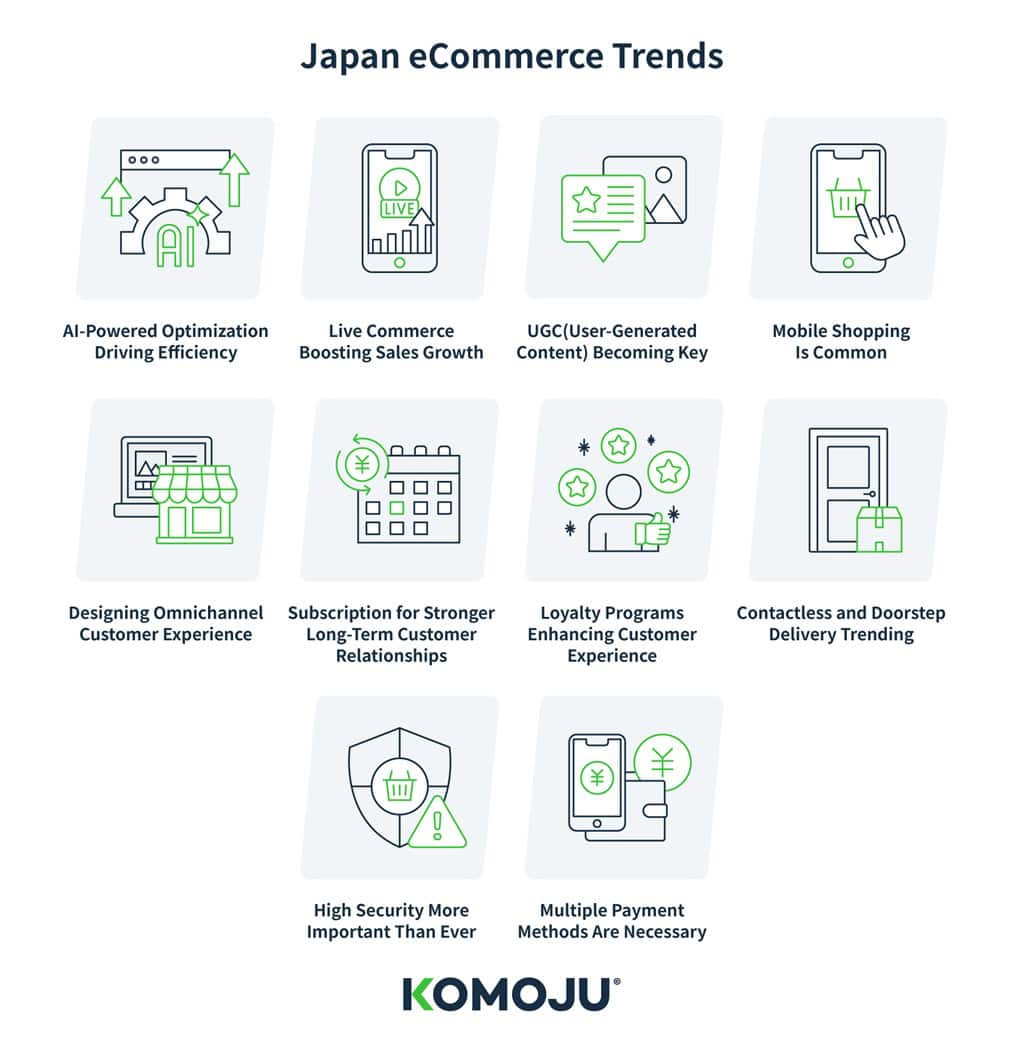
Key trends shaping Japan’s eCommerce market include:
- AI-Powered Optimization Driving Efficiency
- Multiple Payment Methods Are Necessary
- Live Commerce Boosting Sales Growth
- UGC (User-Generated Content) Becoming Key
- Mobile Shopping Is Common
- Designing Omnichannel Customer Experience
- Subscription for Stronger Long-Term Customer Relationships
- Loyalty Programs Enhancing Customer Experience
- Contactless and Doorstep Delivery Trending
- High Security More Important Than Ever
These trends highlight the importance of convenience, trust, and seamless customer experiences in Japan’s eCommerce market.
1. AI-Powered Optimization Driving Efficiency
AI is showing up across Japanese eCommerce in two practical ways: improving the shopping experience and reducing the manual work required to run a store.
On the customer side, AI helps shoppers find relevant products faster through better search, recommendations, and support. On the operations side, it’s increasingly used to speed up tasks like writing product descriptions, categorizing listings, translating copy, and generating basic page content.
You’ll also see “agentic commerce (Japanese)” used to describe AI that can search, compare, and take action on a shopper’s behalf. In Japan, this is still early. Most AI tools help customers browse and decide, but purchases still usually happen through a standard checkout flow rather than a fully integrated chatbot. However, this model is increasingly being discussed as a potential future trend.
Customer Experience Improvement
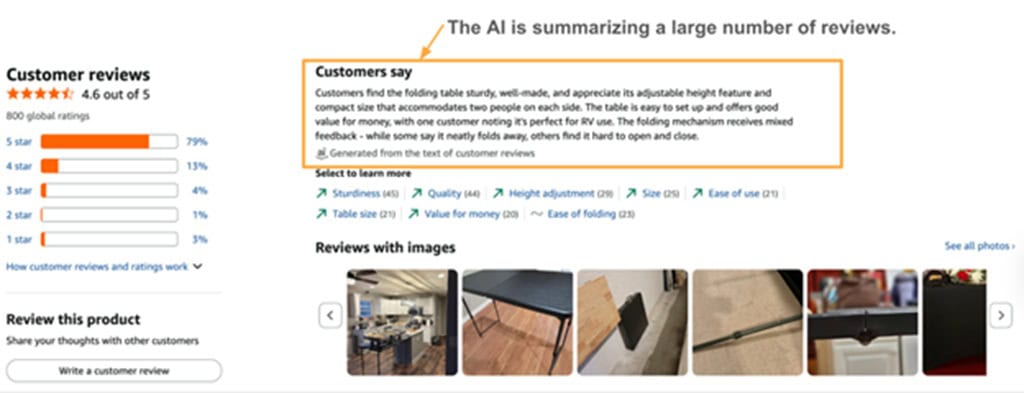
In Japan, product pages tend to be information-dense and review-driven. Thus, personalization serves as a filter, helping users navigate large volumes of detailed content, surface more relevant products, and highlight attributes that matter to each shopper.
- Long, highly descriptive reviews are common.
- Consumers often compare multiple listings before purchasing.
- Rankings heavily influence behavior.
Large platforms in Japan, including Amazon and Rakuten, use machine learning to personalize shopping and surface more relevant products. Personalization is also closely tied to points and loyalty ecosystems, helping optimize coupons, campaign timing, and cross-service recommendations.
[AI Summarizes a Large Number of Reviews on Amazon]
Work Efficiency
Rakuten has rolled out AI tools that help sellers create listings faster, including features that suggest categories, product names, and descriptions from uploaded images, as well as merchant tools that generate product copy and support routine store ops.
For overseas brands entering Japan, these tools can speed up the creation of localization-ready listings and reduce manual workload, useful in a marketplace culture where structured listings and clear product info affect discoverability.
2. Multiple Payment Methods Are Necessary
METI reports that cashless payments reached 42.8% in 2024, surpassing the government’s long-standing 40% goal, and it continues to promote a longer-term target of 80%. Credit cards still dominate cashless spending, while barcode payments and convenience store payments (konbini pay) are meaningful shares—useful context for why checkout expectations are diversified rather than “card-only.”
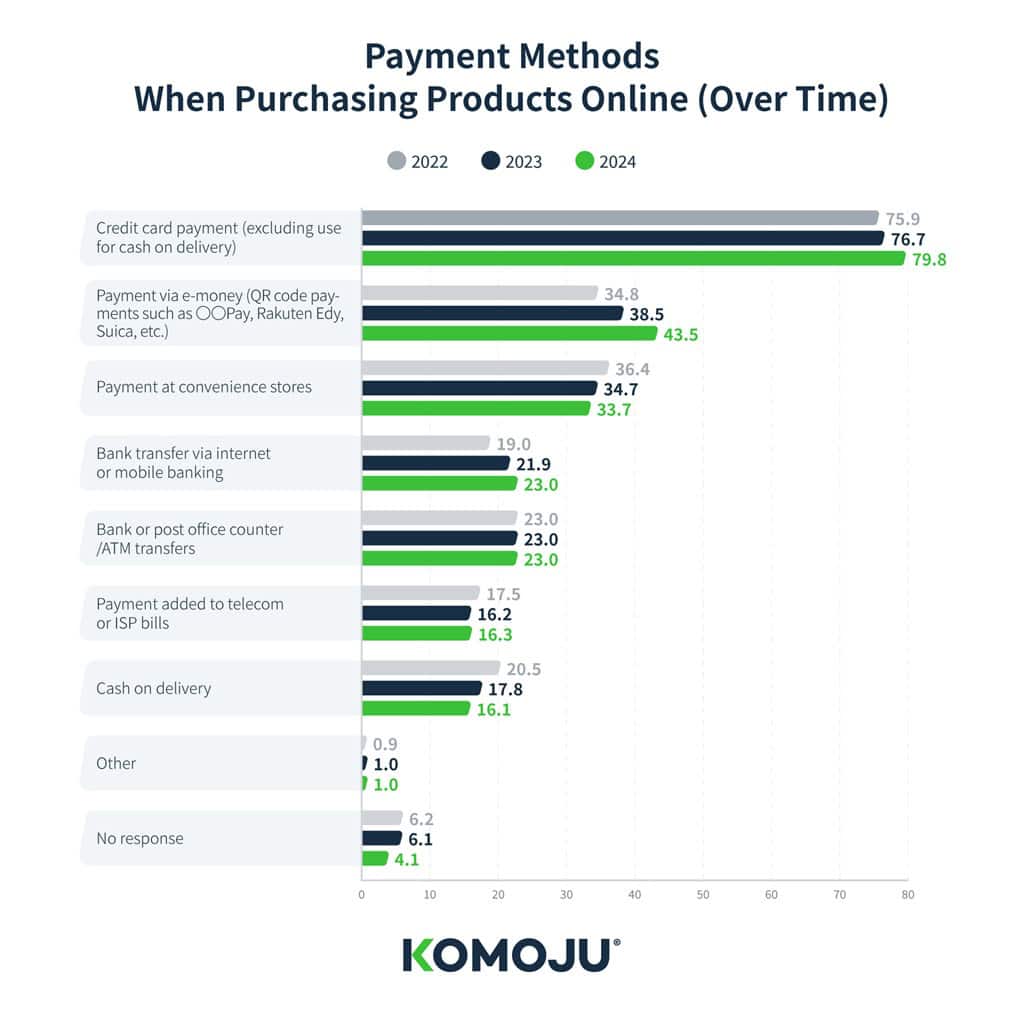
MIC, Communications Usage Trend Survey, 2024
Supporting only one or two options can mean excluding customers who prefer another common method in Japan. KOMOJU is a Japan-focused payment gateway that lets merchants offer multiple local payment methods through a single integration.
Providing local payment options helps reduce cart abandonment and builds trust by offering a familiar and convenient checkout experience for Japanese customers.
For an overview of the preferred payment types in Japan, see KOMOJU’s Guide to Japan’s Payment Methods
3. Live Commerce Boosting Sales Growth
Live commerce refers to livestreamed product demonstrations where viewers can interact in real time and purchase featured items. In Japan, the format is growing across TikTok Shop and YouTube, particularly in cosmetics, fashion, collectibles, and limited-edition goods.
In 2026, YouTube and Rakuten announced a partnership allowing viewers to access Rakuten product listings directly within video content, signaling deeper platform-level investment in social commerce.
Unlike China’s integrated in-stream checkout model, Japanese video commerce typically redirects users to standard marketplace product pages. This keeps transactions aligned with local payment methods and loyalty programs such as Rakuten Points and PayPay, which strongly influence purchase decisions in Japan.
Live commerce is a way to engage customers in real time and showcase products effectively. To maintain a good customer experience, ensuring a smooth path to payment is important.
4. UGC(User-Generated Content) Becoming Key
User-generated content (UGC) has become a powerful tool. In a 2025 survey, more than 60% of Japanese consumers said they check social media information (including peer reviews and ratings) before buying. That figure rises to above 80% among younger demographics.
Research also shows that Japanese shoppers don’t compare products in just one place. They check multiple sources online before buying, and honest reviews, comparison posts, and everyday-use photos help them feel confident they’re choosing the right thing.
Online behavior research by Dentsu Digital also shows that Japanese consumers use multiple sources during the comparison phase of shopping, with most relying on digital channels to evaluate products before buying. In Japan, authentic reviews, comparison posts, and real-use content help reduce purchase risk and guide final decisions.
Encouraging and leveraging authentic customer reviews and social content can build trust and influence purchasing decisions, especially for overseas brands entering the Japanese market.
5. Mobile Shopping Is Common
Mobile devices are central to how people shop online in Japan. According to Japan’s Ministry of Economy, Trade and Industry, about 58.7% of eCommerce transactions are completed on smartphones. Moreover, about 90% of Japanese households use smartphones to access the internet, meaning mobile is often the primary screen for product research, reading reviews, and checkout.
Widespread mobile adoption shapes both design and strategy. Product pages must load quickly and display essential information, including price, shipping fees, delivery dates, and return policies, clearly on smaller screens.
Because mobile traffic dominates, seamless navigation between social apps, marketplace platforms, and payment options matters for sales. If checkout feels unfamiliar or inconvenient on mobile, consumers are more likely to abandon purchases.
6. Designing Omnichannel Customer Experience
Japanese retail operates in an omnichannel environment where digital and physical channels are connected. Japanese shoppers use online channels at multiple stages of the purchase journey, including research and comparison before visiting stores.
Online-to-offline (O2O) behavior is also common:
- Check product availability online before visiting a store
- Compare prices and read reviews on smartphones while in a retail aisle
- Order online for in-store or convenience store pickup
- Earn and redeem loyalty points across digital and physical channels
Because physical retail remains strong in Japan, integrating online storefronts with in-store systems is important. Features such as buy online, pickup in store (BOPIS), unified loyalty accounts, and consistent pricing across channels reduce friction and reinforce customer trust.
Consumers also expect Rakuten Points, PayPay, d Point, or other loyalty benefits to function consistently, whether the purchase is made online or in-store.
By operating in an omnichannel environment, businesses can reach a wider range of customers and maximize opportunities across both digital and physical channels.
7. Subscription for Stronger Long-Term Customer Relationships
Subscription models are a growing part of Japan’s online commerce. According to market research, the Japanese subscription eCommerce market was projected to reach around USD 23.3 billion in 2025 and continue growing rapidly over the coming decade.
There has been high demand for convenience and personalized, recurring delivery across categories such as beauty, food, and digital content. Separate industry estimates also point to a domestic subscription service market approaching ¥1 trillion in value as of 2025, spanning lifestyle, entertainment, and everyday goods.
Because Japanese consumers are comfortable with ongoing engagements and value convenience and consistency, subscription programs can help brands build predictable revenue and closer long-term customer relationships.
Incentives such as auto-renewal pricing, already used by platforms like Amazon Japan and the popular online health store iHerb, along with exclusive member benefits and integrated loyalty points, can further encourage retention and deepen engagement with recurring customers.
Global brands entering the Japanese market can leverage subscription models to build long-term customer relationships. Subscription programs drive predictable revenue, repeat purchases, and stronger customer loyalty.
8. Loyalty Programs Enhancing Customer Experience
Points systems are deeply embedded in how people shop. Many consumers treat points as a real part of their budget, and the ability to earn or redeem points can strongly influence where and when they buy.
According to a 2026 industry report from Research and Markets, Japan’s loyalty market is projected to reach US$3.54 billion in 2026 and grow to US$5.48 billion by 2030, reflecting the scale and commercial importance of point-based ecosystems in the country.
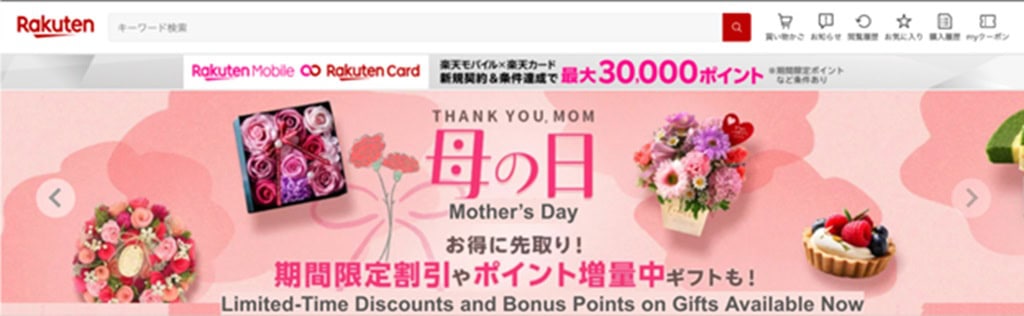
Most major marketplaces and retailers use points-based systems that reward spending with redeemable credits. Customers earn points not only through purchases but also through promotions and seasonal campaigns, and then apply those points toward future orders. Limited-time “points back” events, especially during big sales, can boost purchase activity.
[Rakuten Ichiba Seasonal Point Boost Campaigns]
Common features of Japanese loyalty programs include:
- Points earned per purchase (often 1% or higher during campaign periods)
- Temporary point multipliers tied to promotions
- Cross-service earning and redemption within broader ecosystems
- App-based tracking and digital wallet integration
- Member-exclusive coupons and early access to sales
Loyalty programs help global brands in Japan drive repeat purchases and build long-term customer loyalty.
9. Contactless and Doorstep Delivery Trending
Japan’s delivery system operates at a massive scale. In 2023, approximately 5 billion parcels were handled nationwide. Government data shows that 8.4% of parcels required redelivery, meaning millions of repeat delivery attempts each month.
Reducing redeliveries has become a national logistics priority. Between 2018 and 2019, redelivery rates hovered around 15–16%, placing heavy strain on drivers. While the rate has since fallen, Japan has pushed to expand unattended delivery, parcel lockers, and flexible scheduling.
Major carriers such as Yamato Transport, Sagawa Express, and Japan Post support:
- Doorstep drop-off
- Time-slot selection
- App-based tracking and rescheduling
- Convenience store pickup
- Secure parcel lockers in apartments and train stations
In major cities, next-day delivery is standard, and same-day options are often available. Unlike markets where package theft is common, Japan’s relatively low theft rates allow unattended delivery to function at scale. High social trust and dense urban infrastructure make secure drop-offs viable even in metropolitan areas.
In Japan, efficient contactless and doorstep delivery options help reduce redeliveries and meet high consumer expectations for fast, convenient service.
10. High Security More Important Than Ever
Fraud involving online platforms and digital payments has increased in recent years. According to Japan’s National Police Agency, people in Japan lost a record ¥324.11 billion to scams and fraud in 2025.
In response, Japan’s credit card industry and regulators strengthened security requirements for online payments. Updated credit card security guidelines, promotion of EMV 3-D Secure (3DS2) and stronger authentication measures that verify a customer’s identity through multiple factors such as passwords, SMS codes, or biometric checks.
These measures are now standard across Japanese platforms and marketplaces. They are designed to reduce fraud while keeping checkout friction low through risk-based authentication that only triggers additional verification when needed.
Data protection is equally important. PCI DSS Version 4.0, which became fully mandatory in March 2025, introduced stronger requirements for authentication, encryption, and ongoing security monitoring for organizations that store, process, or transmit cardholder data.
For a better idea of the latest requirements in Japan, see Japan’s Credit Card Security Guidelines.
To succeed in Japan’s eCommerce market, strong security measures are essential. Not only do they protect transactions, but they also build customer trust, as shoppers can be cautious when buying online.
Japanese eCommerce Sales Rules and Regulations
Japan’s eCommerce market is well-developed but highly regulated. Businesses selling to Japanese consumers must comply with consumer protection, data privacy, and platform transparency requirements.
1. Act on Specified Commercial Transactions (特定商取引法[Tokutei Shotorihiki Ho])
This is the core consumer protection law for online sales. It requires merchants to clearly display:
- Seller name and address
- Contact information
- Pricing and additional fees
- Delivery timing
- Return and cancellation policies
Failure to provide proper disclosure can result in administrative action or suspension. For foreign businesses, proper Japanese-language disclosure is essential.
2. Act on the Protection of Personal Information (APPI)
Japan’s data privacy law applies to businesses that handle personal data of individuals in Japan, including foreign companies that sell cross-border. It requires:
- Clear purpose-of-use disclosure
- Proper consent for data transfer overseas
- Security controls to prevent data leaks
- Procedures for responding to user data requests
Cross-border data transfers must meet specific adequacy or consent standards. This directly affects checkout flows, payment data handling, and CRM systems.
3. Act on Improvement of Transparency and Fairness in Trading on Specified Digital Platforms
This law primarily targets large marketplace operators, which must:
- Disclose ranking algorithms and fee structures
- Provide dispute resolution mechanisms
- Submit annual transparency reports to METI
While this applies to platforms rather than individual merchants, it affects how businesses operate within major marketplaces.
4. Competition and Antitrust Oversight
The Japan Fair Trade Commission (JFTC) monitors:
- Marketplace dominance
- Platform self-preferencing
- Exclusive contracts
- Unfair trade practices
This ensures competitive neutrality, especially within large digital platforms.
5. Category-Specific Regulations
Certain products require additional compliance:
- Cosmetics and supplements (Pharmaceutical and Medical Device Act)
- Food labeling standards
- Alcohol licensing
- Electronics certification
Foreign brands entering Japan must confirm whether local representation or an Importer of Record is required.
Summary | Japan eCommerce Trends
Japan is the world’s fourth-largest eCommerce market. Online sales reached ¥26.1 trillion in 2024, and the market continues to grow. The following points are key to success in Japan’s eCommerce market.
- Sellers need clear pricing and return terms, and must handle personal data properly.
- Shopping is influenced by AI recommendations, livestreams, and social proof like genuine reviews and rankings.
- Phones are the main shopping device, so pages must load fast and show key info clearly.
- Many shoppers move between online and offline, use subscriptions, and follow points campaigns.
- To compete, brands need reliable delivery, strong security, and multiple payment methods. KOMOJU supports merchants with a wide range of Japanese payment methods through a single integration, while also offering solutions beyond traditional eCommerce. These include in-store payment support and payment links that allow businesses to complete transactions by simply sharing a URL.
As a result, KOMOJU is a strong option for merchants looking to expand into omnichannel commerce and deliver a seamless payment experience across both online and offline channels.
We help businesses accept payments online.