
We help businesses accept payments online.
Cross-border eCommerce is the process of selling products or services online to customers in other countries. Cross-border eCommerce empowers brands to scale globally by reaching customers in high-growth international markets. Unlike domestic eCommerce, these transactions often involve international logistics, currency conversion, and cross-border payment processing.
For example, when a shopper in the United Kingdom orders South Korean skincare products that are shipped from South Korea, the purchase is considered a cross-border transaction.
Cross-border eCommerce platforms support international online shopping, and Asia is one of the fastest-growing regions. This guide introduces major platforms across Asia and explains how businesses can choose the right one.
TL; DR: Expanding into Asian eCommerce means choosing between running your own platform or selling through established marketplaces, and there’s no universal right answer. What does matter, regardless of which route you take, is localization, especially payments. Shoppers in Japan, Korea, and Southeast Asia expect to pay their way, and friction at checkout is where conversions are lost.
What Cross-Border eCommerce Platforms Are and the Different Types
Cross-border eCommerce platforms are online systems that allow businesses to sell products to customers in other countries through digital storefronts or marketplaces. Platforms and features can vary depending on the company’s business model and needs.
In general, cross-border eCommerce platforms can be divided into two main types: in-house eCommerce platforms and eCommerce malls (marketplaces).
In-House eCommerce
In-house eCommerce platforms allow businesses to build and operate their own online store independently. Stores can be customized to meet business needs, while inventory, orders, and operations are managed internally.
While they provide greater control and security, they can be expensive to build and maintain. This makes them more suitable for larger businesses that have the resources and in-house technical expertise to manage them.
eCommerce Mall
An eCommerce mall functions as an online shopping mall where multiple sellers operate their own stores on a shared platform. There are three types of eCommerce malls:
Marketplace eCommerce (EC) Malls
Marketplace EC malls (e.g., Amazon) allow vendors to list their products on an existing marketplace platform, shared with other sellers. Instead of building and managing an independent website, businesses register as sellers and create product listings.
While this saves time, effort, and operational costs, it can be challenging to create a strong brand identity and differentiate products from competitors.
Tenant eCommerce (EC) Malls
Tenant EC malls (e.g., Rakuten, Tmall, Lazada) allow vendors to operate dedicated storefronts on a shared platform, making it easier to promote their brand and manage multiple products.
They do involve higher operational costs and more resources to manage effectively than marketplace EC malls.
Integrated management EC mall
An integrated management EC mall consolidates multiple corporate brands and transforms them into a single online mall.
This model is often used by companies with multiple brands to manage inventory, logistics, and marketing through a single platform. Fast Retailing uses this approach to manage brands such as Theory, Uniqlo, and GU.
Advantages of Cross-Border eCommerce Platforms
Cross-border eCommerce platforms make it easier for businesses to reach customers worldwide.
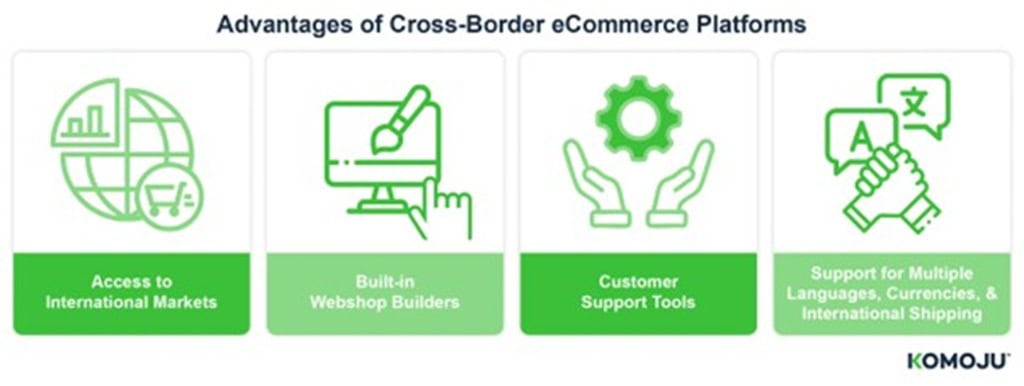
Key benefits include:
- Access to International Markets: Businesses can reach new international customers and expand brand visibility.
- Built-in Webshop Builders: Businesses can create and manage online stores without advanced technical knowledge.
- Customer Support Tools: Platforms help businesses manage inquiries and service requests.
- Support for Multiple Languages, Currencies, and International Shipping: Businesses can serve customers in different countries.
Key Points to Consider When Choosing an eCommerce Platform
Asia offers many eCommerce platforms, and each market has unique consumer behavior, payment preferences, and logistics networks. Each platform offers different features, costs, and regional strengths, making platform selection critical for successful market entry.
Important factors businesses should evaluate before selecting a platform include:
- Initial and ongoing platform costs
- Ability to handle multiple languages and currencies
- Support for localized payment methods
Does the Initial and Ongoing Cost Fit Your Budget?
When evaluating eCommerce platforms, businesses should consider both the initial setup costs and the ongoing costs required to run the platform.
- Initial Costs: These can include store development or customer onboarding fees.
- Ongoing Costs: These typically cover subscription fees, transaction charges, hosting costs, and third-party integrations.
Note that these operating costs may increase as your business grows and your requirements scale.
Understanding the total cost of ownership helps businesses choose a platform that aligns with their budget and supports long-term growth.
Can It Handle Multiple Languages and Currencies?
Supporting multiple languages and currencies helps businesses provide localized shopping experiences and build trust.
When selling internationally, businesses should choose platforms that support multiple languages so product pages, checkout pages, and customer communication are accessible to local customers. Multi-currency support is also important, allowing customers to view prices and complete purchases in their local currency.
Does It Support Localized Payment Methods?
Local payment methods are important for expanding your business, and supporting region-specific payment options is essential for successful cross-border expansion.
Payment preferences vary across countries, making localized payment methods an important factor when choosing a cross-border eCommerce platform. Customers are more likely to complete purchases when they can use familiar payment options commonly used in their region. This reduces checkout friction, builds customer trust, and improves conversion rates.
Integrating payment solutions such as KOMOJU enables merchants to support multiple local and global payment options through a single system, making it easier to meet customer preferences across different regions.
Popular In-House eCommerce Platforms
Many businesses entering cross-border eCommerce begin by building their own in-house eCommerce platforms. This gives them control over branding, store management, and customer experience.
The following platforms are widely used by businesses launching and scaling international eCommerce websites.
Platform | Type | Cost | Key Features |
Shopify | 🛒 Hosted SaaS | Monthly subscription |
|
WooCommerce (WordPress) | 🔧 Open-source plugin | Free plugin + hosting costs |
|
Wix | 🧩 Website builder | Tiered monthly plans |
|
Magento (Adobe Commerce) | 🏗 Enterprise open-source | Free version or enterprise pricing |
|
Salesforce Commerce Cloud | ☁ Enterprise SaaS | Enterprise pricing |
|
SHOPLINE | 🌏 Asia-focused SaaS | Subscription plans |
|
Cafe24 | 🌐 Global SaaS | Free and paid plans |
|
BigCommerce | 📈 Scalable SaaS | Monthly subscription |
|
Many of these platforms integrate with payment solutions such as KOMOJU. As a unified payment gateway, KOMOJU helps merchants support a wide range of local payment methods across Asia through a single integration, reducing cross-border payment friction. Here is a list of supported integrations.
Shopify
Shopify is a popular subscription-based eCommerce platform that allows businesses to build and manage online stores, making it ideal for small and medium-sized businesses without technical expertise.
Key features include:
- User-Friendly Store Builder
The interface is intuitive with drag-and-drop tools and ready-made templates.
- Store Management Tools
The platform includes a centralized dashboard for managing inventory, tracking orders, and analyzing sales performance.
- Payment Processing and Integrations
Built-in payment processing with the option to easily integrate payment gateways like KOMOJU to offer localized payment options and reach customers in different markets.
WooCommerce (WordPress)
WooCommerce is a free open-source WordPress plugin that allows businesses to build customizable online stores, making it a great choice for businesses that want greater control over their website design, branding, and functionality.
Key features include:
- Open-Source Customization
WooCommerce allows businesses to customize nearly every aspect of their online store.
- Strong SEO Capabilities
Because it runs on WordPress, WooCommerce offers strong SEO capabilities.
- Flexible Payment Integrations
WooCommerce supports multiple payment gateways and integrations. Merchants can support localized payment methods by connecting to payment providers like KOMOJU.
Wix
Wix is a subscription-based, drag-and-drop website builder for creating online stores without coding. Wix is particularly suitable for beginners, small business owners, creators, and freelancers looking to create professional sites without coding.
Key features include:
- Drag-and-Drop Website Builder:
Wix provides an intuitive editor and templates for designing online stores without coding.
- Built-In Marketing Tools
Wix includes built-in marketing tools.
- Payment and App Integrations
Wix supports multiple payment providers and app integrations, allowing businesses to connect payment solutions such as KOMOJU to support localized payment methods.
Magento
Magento (now Adobe Commerce) is an open-source platform with free and enterprise editions designed for large businesses with complex product catalogs. It often requires dedicated development teams due to its scale and complexity.
Key features include:
- Advanced Customization
Magento helps meet specific business requirements by allowing developers to fully customize store functionality, design, and integrations.
- Scalable Architecture
The platform supports large product catalogs, multiple storefronts, and high traffic volumes, making it suitable for growing enterprises.
- Flexible Integrations
Magento supports integrations with various third-party tools, including payment solutions such as KOMOJU, enabling merchants to offer localized payment methods for international customers.
Salesforce Commerce Cloud
Salesforce Commerce Cloud (now known as Agentforce) is an enterprise cloud-based platform with revenue-based pricing designed for large retailers and global brands that require advanced personalization and omnichannel capabilities. It provides advanced tools for managing online sales, customer experiences, and omnichannel commerce operations.
Key features include:
- AI-Driven Personalization
The platform uses artificial intelligence to deliver personalized shopping experiences, product recommendations, and targeted marketing campaigns.
- Omnichannel Commerce Support
Salesforce Commerce Cloud enables businesses to manage sales across multiple channels, including online stores, mobile apps, and physical retail locations.
- Advanced Analytics and Customer Insights
The platform provides detailed data analytics to help businesses understand customer behavior and optimize marketing strategies.
SHOPLINE
Founded in Hong Kong, SHOPLINE is a subscription-based eCommerce platform with a strong focus on Asian markets. It helps small and medium-sized businesses build and manage online stores by supporting merchants looking to expand through social commerce, cross-border sales, and omnichannel retail strategies.
Key features include:
- Omnichannel Selling Tools
SHOPLINE helps businesses sell across multiple channels, including online stores, social media platforms, and mobile commerce.
- Marketing and Automation Tools
The platform provides built-in marketing tools such as customer segmentation, promotional campaigns, and automated messaging.
- Flexible Integrations
SHOPLINE supports integrations with various third-party services, including payment providers such as KOMOJU, enabling merchants to offer localized payment methods across different regions.
Cafe24
Cafe24 is a South Korean eCommerce platform offering both free and paid plans for online stores.
Key features include:
- Global Store Management
Cafe24 helps businesses operate multiple storefronts and manage international sales from a single platform.
- Localization Support
The platform supports multiple languages and currencies to help merchants provide localized shopping experiences.
BigCommerce
BigCommerce is a subscription-based eCommerce platform designed to help businesses build, manage, and scale online stores. It is known for its strong scalability and built-in features that support growing businesses that need a scalable eCommerce infrastructure without extensive development resources.
Key features include:
- Scalable Store Infrastructure
BigCommerce supports large product catalogs and high transaction volumes, making it suitable for businesses planning to scale their online operations.
- Flexible Integrations
BigCommerce integrates with various third-party services, including payment providers such as KOMOJU, allowing merchants to support localized payment methods.
Top Japanese eCommerce Malls
Japan has one of the largest online shopping markets in Asia with a mature eCommerce ecosystem. Major marketplaces offer access to millions of consumers and established logistics networks.
Major Japanese eCommerce Marketplaces
Platform | Marketplace Type | Key Features | Best For |
Amazon Japan | 🛒 Marketplace EC Mall |
| Global brands and retailers seeking a broad market reach and efficient logistics |
Rakuten Ichiba | 🏬 Tenant EC Mall |
| Brands wanting to build long-term customer relationships and a strong brand identity |
Yahoo! JAPAN Shopping | 🌐 Marketplace EC Mall |
| Small and medium-sized businesses looking for an accessible entry into the Japanese market |
Amazon
Amazon Japan is one of the largest online marketplaces in Japan, providing businesses with access to millions of active online shoppers. A major advantage of the platform is the Fulfillment by Amazon, which allows merchants to outsource storage, shipping, and customer service.
Amazon Japan is well-suited for large retailers, global brands, and businesses that rely on efficient logistics and high product visibility to reach a broad consumer market.
Rakuten Ichiba
Rakuten Ichiba is one of Japan’s largest eCommerce malls and uses a tenant-style marketplace model where merchants run their own storefronts.
Businesses can build branded store pages and manage multiple products while benefiting from Rakuten’s marketing tools and loyalty program, which encourages repeat purchases.
It is beneficial for businesses that want to build a strong brand identity and long-term customer relationships while selling multiple products through a dedicated storefront.
Yahoo! Shopping
Yahoo! Shopping is a major Japanese online marketplace that allows small and medium-sized businesses to sell products through the Yahoo Japan ecosystem. It is accessible with low entry barriers and integrates with PayPay, one of Japan’s most widely used digital payment services, which helps drive customer traffic and promotional campaigns.
Top South Korean eCommerce Malls
South Korea has one of the most advanced digital commerce markets in Asia, with high internet penetration and strong mobile shopping adoption.
Major South Korean marketplaces have established logistics and payment ecosystems that allow both international and domestic sellers to reach local consumers.
Major South Korean eCommerce Marketplaces
Platform | Marketplace Type | Key Features | Best For |
Coupang | 🛒 Marketplace EC Mall | Rocket Delivery, next-day shipping, strong logistics network | Large retailers and fast-moving consumer brands |
11STREET | 🌐 Marketplace EC Mall | Promotional campaigns, sales events, and product visibility tools | Small and medium-sized businesses seeking marketplace exposure |
GMarket | 🌏 Marketplace EC Mall | Reward systems, product reviews, and international ordering | International sellers targeting South Korean consumers |
Coupang
Coupang is South Korea’s largest eCommerce mall and is often compared to Amazon due to its wide product range, fast delivery services, and strong logistics network.
A major differentiator is Rocket Delivery, a service that provides fast order fulfillment and next-day delivery across many regions in South Korea.
11STREET
11STREET is a major South Korean eCommerce platform offering a broad range of products, including fashion, home goods, electronics, and cosmetics. The marketplace provides tools for promotional campaigns, product visibility, and sales events that help small and medium-sized businesses attract customers within the platform.
GMarket
GMarket is one of South Korea’s largest online marketplaces and provides a wide range of product categories.
The platform offers features such as reward point systems, product reviews, and international ordering options, which make it accessible to both local and overseas customers. GMarket is well-suited for international sellers and brands that want to reach South Korean consumers while also offering cross-border shipping to global buyers.
Top Chinese eCommerce Malls
China has the largest eCommerce market in the world and is home to several major digital marketplaces. Many Chinese platforms operate within integrated digital ecosystems.
Platform | Marketplace Type | Key Features | Best For |
🌏 Cross-border Marketplace |
| Global brands entering the Chinese market | |
🏢 Marketplace EC Mall |
| Brands prioritizing fast delivery and product authenticity | |
📱 Social Commerce Marketplace |
| Businesses targeting price-sensitive consumers |
Tenneko
Tenneko is a Chinese eCommerce platform focused on facilitating cross-border trade between international businesses and Chinese consumers.
The platform supports global merchants by providing tools for product listings, logistics coordination, and cross-border order management. These services simplify selling into the Chinese market for international brands and exporters.
Kyungdong Business City
Kyungdong Business City is an online marketplace that focuses primarily on wholesale trade and B2B commerce. The platform connects manufacturers, suppliers, and distributors through a centralized marketplace where businesses can source products and manage supply chains.
Kyungdong Business City is best suited for wholesale buyers, distributors, and businesses looking to source products from Chinese suppliers or manage B2B transactions at scale.
Pinyin
Pinyin is an eCommerce platform designed to connect international merchants with Chinese consumers through localized online storefronts. The platform offers tools that help small and medium-sized international businesses manage product listings, payments, and cross-border logistics while adapting to local market requirements.
Top Southeast Asia eCommerce Malls
While Japan, South Korea, and China represent mature eCommerce markets, Southeast Asia is a rapidly growing region where businesses can reach customers across multiple countries.
Platform | Marketplace Type | Key Features | Best For |
Shopee | 🛒 Marketplace EC Mall | Mobile-first platform, promotional campaigns, strong regional presence | Small and medium-sized businesses targeting Southeast Asian consumers |
Lazada | 🏬 Marketplace EC Mall | Strong logistics infrastructure, Alibaba ecosystem integration, and regional reach | Brands expanding across multiple Southeast Asian markets |
Tokopedia | 🌏 Marketplace EC Mall | Large Indonesian user base, seller tools, and local logistics integrations | Businesses targeting the Indonesian eCommerce market |
Shopee
Shopee is one of the largest eCommerce platforms in Southeast Asia. The platform offers in-app promotions, flash sales, and integrated logistics services that help merchants reach customers across multiple Southeast Asian markets.
Shopee is ideal for small and medium-sized businesses that want to reach a large consumer base across countries such as Indonesia, Malaysia, Thailand, and Vietnam.
Lazada
Lazada is a major Southeast Asian eCommerce platform operated by the Alibaba Group.
The platform provides robust logistics infrastructure, payment solutions, and marketing tools to help businesses manage cross-border sales in the region. Lazada is well-suited for established brands and larger retailers that want to scale their operations across Southeast Asia using Alibaba’s regional logistics and commerce ecosystem.
Tokopedia
Tokopedia is one of Indonesia’s largest online marketplaces and serves a large domestic customer base.
The platform enables merchants to create storefronts and sell products across a wide range of categories, including electronics, fashion, and household goods. Tokopedia is beneficial for businesses targeting Indonesia’s rapidly growing digital economy, particularly for merchants serving local consumers in the country’s large online retail market.
Summary | Choose a Cross-Border eCommerce Platform That Fits Your Business Style
Cross-border eCommerce platforms allow businesses to expand beyond their domestic markets, whether companies choose to operate their own online stores or sell through established online marketplaces.
Asian markets offer growth potential for cross-border eCommerce, with countries such as Japan, South Korea, China, and Southeast Asian nations providing access to large and active online consumer bases.
When selecting a platform, businesses should consider factors such as costs, scalability, localization features, and payment support to ensure it aligns with their expansion strategy.
Integrating payment solutions such as KOMOJU can also simplify international expansion by enabling merchants to support localized payment methods and improve the checkout experience for customers in different regions.
FAQ
It depends on your business needs. In-house platforms offer more control and customization but require more resources to build and manage. eCommerce malls make it easier to start selling quickly and reach a wider audience, though they offer less control over branding.
Customers are more likely to complete purchases when they can use familiar payment methods. Offering local options reduces checkout friction, builds trust, and helps prevent cart abandonment.
Not always. Platforms like Shopify allow businesses to build stores without coding, while platforms like WooCommerce may require more technical knowledge.
Learn more about the differences between Shopify and WooCommerce.
We help businesses accept payments online.